

The project of restoring and renovating the tomb of the Prophet Nahum in Iraq has recently been completed
But the work of restoration and renovation was done secretly and in great danger. Until now, we have not been allowed to publish about the renovation project, for fear of the safety of two Israeli engineers who were brought into Iraq for this purpose. Even after the renovation is completed, some of the details are censored, so as not to reveal to our enemies the methods that may also be used in the future
Last month, a conference was held at the Babylonian Jewish Heritage Center in Or Yehuda to unveil the renovation project. The information we heard at the conference about the renovation project could provide material for a Hollywood drama or a Netflix suspense series
In northern Iraq is the province of Nineveh, where the town of Elkosh is located. The prophet Nahum lived and worked there, as it is written in the Bible: "The burden of Nineveh. The book of the vision of Nahum the Elkoshite" (Nahum 1:1). Today Elkosh is a Christian-Assyrian town with a minority of Yazidis. In the past, there was also a Jewish community from the days of the kingdom of Judah until the establishment of the State of Israel. The main synagogue was adjacent to the tomb of Nahum

The Kurdish Jews had a tradition to make a pilgrimage to Elkosh on the Shavuot holiday (Pentecost), which they called "Eid al-Ziara". The custom was to celebrate there with a mass picnic and Torah study for two weeks, starting with the 28th of Iyar. Thousands of Jews from Persia and Turkey came to the tomb during Shavuot. Some stayed in the compound for the entire two weeks, and some came for just a few days. In 1796, the adjusted Dahockhya Yard was expanded, and more rooms and halls were built on its outskirts to accommodate the many pilgrims. In 1950, after the establishment of the State of Israel, the Jewish community of Elkosh immigrated to Israel in 'Operation Ezra and Nehemiah'. Since then, very few Jews have come to the Tomb of Nahum on Shavuot. The glorious tradition has faded, But it may be renewed. The inauguration ceremony of the renovated site was deliberately scheduled for three days before the upcoming Shavuot
Eight years ago, ISIS forces captured Nineveh province in northern Iraq, killing genocide Yazidis and Assyrian minorities. They left a ruin everywhere, destroying heritage sites of non-Muslim religions. Thus Nachum predicated on the destruction of the city of Nineveh, which is called Mosul nowadays: "Woe to the bloody city! It is all full of lies and rapine; the prey departeth not. Hark! the whip, and hark! the rattling of the wheels; and prancing horses, and bounding chariots; The horseman charging, and the flashing sword, and the glittering spear; and a multitude of slain, and a heap of carcases; and there is no end of the corpses, and they stumble upon their corpses" (Nahum 3:1-3). This prophecy was also fulfilled in our generation, 2,600 years after Nahum cried it out
Across Iraq there were Jewish heritage sites, which for many generations were focal points for Jewish pilgrimage tourism. The sites of the Jewish heritage suffered an arm's length from ISIS jihadists. In the summer of 2014, they blew up and completely destroyed the tomb of the prophet Jonah, in the city of Mosul in northern Iraq. They also destroyed Daniel's tomb in Kirkuk Fortress in Iraq. At the tomb of the prophet Ezekiel, in the village of Chipil, south of Baghdad, they smashed marble plaques with Hebrew inscriptions, causing damage to its tomb and structure
In addition, these barbarians blew up all the Christian churches everywhere, except the largest and most beautiful in each town, which they planned to turn into a mosque. They also advanced on the campaign of conquest to the outskirts of Elkosh, and miraculously were stopped only 3 km before Nahum's tomb. "If ISIS had advanced these three kilometers, it is a certainty that Nahum's tomb would not have survived either" says Meir Ronen
When U.S. troops arrived in Iraq, they pushed ISIS out of most of its areas of control. Adam Tiffen, a Jewish U.S. Army veteran from Long Island who previously served two tours in Iraq, visited the tomb in 2016. He was there as the Deputy Director, of the Alliance for the Restoration Cultural Heritage (ARCH), and was amazed by the stone signs carved with Hebrew letters in the tomb complex. Adam well remembered the preparations for his Bar Mitzvah at Beit Chabad at Coram, Long Island
At the time, the U.S. administration decided to encourage Yazidi refugees to return to their homes, and to help the local population rehabilitate and renovate their private homes and public buildings. ARCH International, which was founded by Dr. Cheryl Benard, decided to take on the difficult task of saving the tomb of the prophet Nahum. Dr. Benard coordinated the approval of the Kurdish authorities, and the restoration project began in 2018
Adam used to visit Israel almost every year, and after the restoration began, he and Dr. Benard traveled to Israel in 2019 to conduct research and to interview people from the Jewish Kurdistan community. He contacted the president of the Kurdish community, Yehuda Ben Yosef, a member of the Jerusalem Municipal Council. It was important for Yehuda Ben Yosef to receive rabbinical approval, and he initiated a meeting for Adam with Chief Rabbi, Shlomo Amar. "I presented the rabbi with pictures from the ruins of Nahum's tomb, and he gave us the blessing to hit the road", says Adam.

Following this, contact was also made with the Minister of the Interior, Rabbi Aryeh Deri, who was enthusiastic about the project and assisted in removing obstacles, without written fingerprints
Behind the scenes in this project, former Knesset member, Ksania Svetlova, also worked hard. She established the "Parliamentary Lobby for the Cultivation and Preservation of the Culture of the Jews of the Islamic Lands" especially for this purpose. On behalf of that lobby she appealed to UNESCO at the UN "To take every precaution to preserve the site of Nahum's Tomb and protect it from harm". She also approached other international bodies, and aroused diplomatic pressure that promoted the project to renovate the Tomb of Nahum
"We were looking for someone suitable for the rescue and renovation of Nahum's tomb complex", says Adam Tiffen. "Instead of hiring local engineers, we preferred experts with experience in preserving ancient Jewish synagogues, who will also have an emotional connection to Judaism. We received a referral from a friend at the Israel Museum, who recommended the 'Schaffer-Ronen Engineers' office in Jerusalem. They did a great job on the restoration of the City of David in Jerusalem, the Tower of David and many other historical sites. That's how Yakov Schaffer and Meir Ronen were brought into the project". i
Initially, Israeli security officials did not allow Yakov and Meir to fly to Iraq, but nevertheless, they landed in April 2017 in the Kurdish region of northern Iraq. The two Israelis landed at Irbil Airport, and from there were transported in separate armored vehicles about 140 km to the town of Elkosh, accompanied by security men. It was a scary journey since the convoy had to pass through several security checkpoints
Only 15 km south of Elkosh, battles were still being fought against ISIS, and echoes of mortars and artillery were heard at nights in Elkosh, and during the days smoke billows from the shelling were visible on the horizon

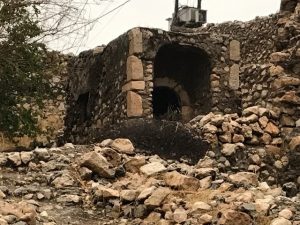
Arriving at the tomb compound, the Israeli engineers saw collapsed ceilings and walls. Yakov and Meir began measuring and mapping everything they saw at the site, the walls, windows, openings, and ceilings. They also defined the original building materials, the types and sizes of stones, and the materials of concrete, plaster, and wood in the windows and doors frames
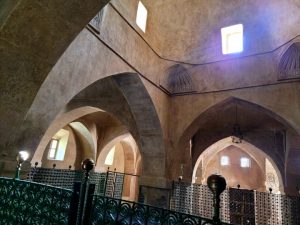
Yakov Schaffer, who previously worked for the Israel Antiquities Authority, identified that the complex was built and developed during different historical periods. He estimates that the main structure above the tomb was built during the Roman period in the second century, about 600 years after the death of the prophet Nahum. Its length and width are about 20 meters. 14 vaults and 9 pillars were built in it, which held a roof with a dome

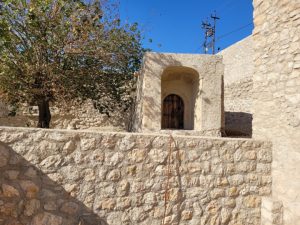
The entrance wall before restoration (above), and after

About a thousand years later, more rooms and small buildings were built around the tomb structure for prayer and study, with small dome roofs side by side. In addition, about 250 years ago, more study and guest rooms were built in such a way that they created a large courtyard with an area of about 50×40 meters, bordered by the shape of letter C. Thus the compound expanded, and it also includes the room above the tomb of Sarah, the sister of the prophet Nahum.

The Dahockhya Yard before restoration (above), and after

The newest construction was of an asbestos roof over the tomb structure, built by Jews from Baghdad in the early 2000s. The "new" asbestos roof also collapsed, causing further damage to the structure. "It would have been better if they had not set it up at all", says Yakov Schaffer

The Israeli engineers discovered destruction, as Nahum predicted "And the palace is dissolved" (Nahum 2:7). The destruction was a result of natural tear and neglect, and of a lack of maintenance. About half of the roof of the main building above the tomb collapsed to the ground. Out of 14 vaults, only 6 remained, and 4 pillars out of 9 collapsed. From what was left, they could sketch what the original structure would have looked like
It was interesting to find that there were more cracks in the walls and more walls that collapsed in the rooms added around the tomb about a thousand years after the construction of the main structure. Yakov explains that they were built from less good building materials and technologies than those of the Roman period
A local priest told Yakov that the bones of Prophet Nahum were exhumed in 1883, and are kept in the local church. According to him, the Jews pray into an empty tomb. This theory is controversial and historians dispute it is true
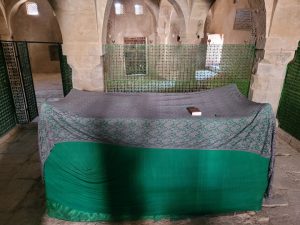
Today the tomb is covered with green cloth, and beneath it is an old wooden covering over the concrete monument. Yakov wanted to dismantle a small piece of wood, to bring it to Israel and to find out when it was built. In his estimation, the concrete monument and the cladding above it were built in the tenth century. He discovered that beneath the exterior siding was an older wood siding, and beneath it an even older siding, as in Russian Matryoshka. At the base of the concrete he did not dare to touch "because of the sanctity of the tomb". i
About a week later, Yakov and Meir returned to Israel with the measurements and drawings they made at the gravesite. In their office they prepared an engineering opinion on the methods and techniques of the structure, on physical failures, conclusions from what the damage was caused, and recommendations of an initial design for restoration and preservation. For each pillar and wall and dome they made a separate plan of what materials and technologies to use. They recommended restoring the site using the original stones that were scattered throughout the compound and trying to put them back in place. The other raw materials were recommended to be taken from the stones of the area
The full engineering-conservation survey was submitted to ARCH. It was clear that it was not possible to bring an Israeli company there to carry out the restoration and rehabilitation work. At that time, a Czech company called GEMA was working on the restoration of the ancient fortress in the city of Erbil. They had also restored the ancient Choli Minaret, and had experience working on UNESCO World Heritage Sites. The working papers prepared by Yakov and Meir were handed over to the Czech engineers, according to which they conducted the necessary studies, prepared a detailed work plan and wrote quantities for the materials
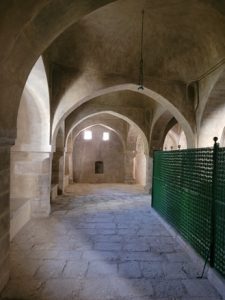
However, Yakov and Meir warned that the wind and rain might cause a complete collapse within a few weeks, if no work was immediately carried out to strengthen the buildings. "Luckily, that year there wasn't rain", says Yakov Chaffer. Cheryl Bernard made an emergency intervention, and in January 2018 the Czechs made temporary reinforcements and supports. Then they started the project. About a month before the end of the restoration, it was stopped due to the Covid19. Only last year did they return to work and completed the project
Today the tomb complex has been restored as it was at the height of its glory. Thus in our generation, ARCH has a rare sacred and historic privilege to fulfill the prophecy of Nahum: "Strengthen thy fortresses; go into the clay, and tread the mortar, lay hold of the brickmould" (Nahum 3:14) (Although Nahum said it about Nineveh)

In the conference held last month at the Babylonian Heritage Center, were also invited people who saw the tomb of Nahum in their childhood. When Meir Ronen presented photographs, they testified that this is exactly how it looked in their youth. One of them burst into tears of excitement, thus shaking the hearts of the audience.
The tomb of the prophet Nahum will be reopened officially on June 1st, just at Shavuot holiday, and will return to being a tourist site and a center of pilgrimage for Jews. But it is impossible to visit it with an Israeli passport yet. ARCH is preparing info signs to be placed on the site, that will explain in Kurdish, Arabic and English the importance of the prophet Nahum and local Jewish history. An app for audio instruction in English is currently being produced, which visitors can download from the Internet, and walk around the complex while hearing explanations of what they see around
Adam Tiffen has visited Elkosh 13 times during the last five years, before, during, and after the renovation. He says that almost every day during work, non-Jewish travelers came to visit the place. Some did not know until then that Jews had once lived in Iraq. Once, a class of 30 architecture students came to the site to learn about the restoration of ancient sites. 3 years ago, Adam eldest son was born, and he gave him the name "Nahum". i
We opened this article with Nahum's prophecy of destroying Nineveh, which also was fulfilled in our generation. May God will that Just as it was fulfilled, so will his prophecy of consolation be fulfilled in our time: "Behold upon the mountains the feet of him that bringeth good tidings, that announceth peace! Keep thy feasts, O Judah, perform thy vows; for the wicked one shall no more pass through thee; he is utterly cut off. A maul is come up before thy face; guard the defences, watch the way, make thy loins strong, fortify thy power mightily!" (Nahum 2:1-2)
Amen