St. Petersburg, a captivating and globally renowned tourist hub, boasts not just its enchanting allure but also harbors intriguing Jewish heritage sites

In the 18th century, during the Ottoman Empire's rule over Israel, tensions brewed between the Russians and their adversaries. Rabbi Schneor Zalman from Ladi, known as "The Old Admor" and "Baal HaTanya," supported his followers immigrating to Eretz Israel by sending financial aid. Unfortunately, perceived as a traitor aiding the Turks by dissenting voices, he was imprisoned in the Petropavli fortress in Petersburg, facing a potential death sentence
The Petropavli fortress, now a picturesque tourist site, stands on an island in the Neva River, connected by two modern bridges. In the 18th century, access was only by boat, a nightly journey for the Rabbi after investigations at the police headquarters in Petersburg

However, after being found innocent, he was released on the 19th day of Kislev in 1798, marking a significant occasion celebrated by Chabad devotees as "Chag Ha-Geula," Redemption Day, annually. The Petropavli fortress, now a prominent tourist spot, stands on an island in the Neva River, accessible through two bridges—unlike the 18th century when boats were the sole means of transport to the island. The Rabbi was escorted to the jail each evening after investigations at the police headquarters in Petersburg
Legend has it that during one moonlit night on the boat to the prison when the Rebbe requested a pause for the "Kiddush Levana" prayer, the Russian captain initially refused. Strangely, the boat's engine halted until the prayer concluded, upon which the engine restarted. Recognizing this as a miraculous event, the captain sought the Rebbe's blessing, acknowledging a higher power

The prison yard today, and the prison's outer wall

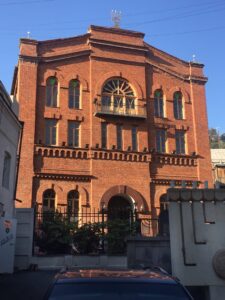
The legacy in Petersburg continues with another significant event from 92 years ago with the 6th admor, Rabbi Yosef Yitzchak Schneorson. The Russian secret police surrounded his residence at 22 Moxovya Street. This house, preserved to this day, serves as a reminder of historical events
This is what the house looks like today: i

From this house, the Rebbe was taken to the Sheplerka prison which still functions today as a prison. A road passes by it, but people are not allowed to stop and take pictures, and today contact with the prisoners inside isn't allowed. Police and guards patrol the nearby sidewalks and enforce it rigorously. Nevertheless, I asked the driver to drive slowly, taking pictures of the building while traveling. It was dangerous, my heart beat wildly, but it went through peacefully

Following international pressure and campaigns by his followers, the death penalty was commuted to a ten-year Siberian exile. Unexpectedly, a week later, the Rebbe was released and escorted home, considered a visible miracle by Chabad Hassidim, celebrating another Hag Geula on 12 on Tamuz
This incredible history brought me, 92 years later, driving the same route—from prison to the Rebbe's home. Despite not being a Chabadnik, the experience of being at the same place on such a significant anniversary was profoundly moving. Sharing these emotions with the Chabad Shaliach, we commemorated the moment by singing and dancing at the Rebbe's doorstep—a truly memorable and spiritually stirring experience

The city today
This historically rich city, once known as Leningrad, shares its lineage with St. Petersburg, named after its founder, Czar Peter the Great. Despite the name changes over the years, the city remains an exquisite gem in Eastern Europe, renowned for its beauty and often referred to as the "Venice of the North" due to its numerous canals and bridges. Exploring the city through canal cruises offers a delightful way to immerse oneself in its beauty and history
Embarking on these captivating cruises allows us to preview numerous tourist attractions, offering a chance to plan our subsequent explorations. Stepping off the boat, we're greeted by the breathtaking grandeur of one of the city's magnificent palaces adorned with opulent golden cornices on windows and ceilings, hosting an array of renowned paintings


Embarking on these captivating cruises allows us to preview numerous tourist attractions, offering a chance to plan our subsequent explorations. Stepping off the boat, we're greeted by the breathtaking grandeur of one of the city's magnificent palaces adorned with opulent golden cornices on windows and ceilings, hosting an array of renowned paintings

The crown jewel among the city's attractions is the Hermitage Museum, often likened to the illustrious "Louvre of Russia." Spanning six buildings, the museum's initial structure served as the Tsar's Winter Palace, a colossal edifice with striking blue, green, and white façades accessible from the River Station

Helpful tips for a seamless visit: 1- Secure tickets in advance to bypass potentially lengthy entry queues. 2- Prior to entry, deposit bags, umbrellas, bottles, and coats on the bus, as these items aren't permitted inside. 3- Avoid wearing high-heeled shoes to protect the museum's exquisite hardwood floors from potential damage

The museum's vast halls are categorized by origin and artists, offering a diverse journey through history and artistry. From the Egyptian Hall showcasing sarcophagi and mummies with inscriptions to the Italian and Dutch halls exhibiting paintings, sculptures, and masterpieces by renowned artists like Van Gogh and Rembrandt. Particularly captivating was the biblical depiction of the "Akedat Yitschak" the Binding of Isaac

Wandering through the expansive corridors, portraits of the Russian Tsars and Tsarinas embellish the walls, narrating the rich tapestry of Russian history


Despite housing approximately 3 million pieces, only a fraction is on display, with curators rotating exhibits every three months, ensuring returning visitors encounter new works. Art enthusiasts could easily lose themselves in the museum's wonders for 3-4 days
Address: Dvortsovaya nab. 34
Exiting the museum leads us to "Palace Square," home to the emotive "Symbol of Sorrow" statue at its center. Across the square sits the resplendent yellow General Staff Palace, accommodating various government offices and the Foreign Office

As picturesque carriages grace the square, inviting us to partake in a historic city tour

Tip: Beware of pickpockets in the square. They have sophisticated methods. Beautiful young women like  these, dressed in Tsarina-style attire, walk around the front of the museum, offering to be photographed with you. While trying to find the perfect spot for the pictures, they move around a lot. Their accomplice then waits for the perfect moment to steal your valuables when they are temporarily placed on the floor for the photo
The Summer Palace
However, the pinnacle of opulence lies in Catherine's Summer Palace, situated in Pushkin, approximately 30 km from Petersburg. Formerly part of Petersburg, the area was renamed in honor of Alexander Pushkin's 100th anniversary. Its landscaped gardens rival Versailles, complete with golden fountains of diverse shapes and sizes


Yet, the courtyard's magnificence pales in comparison to the resplendent interior of the palace. Each hall surpasses the previous in sheer beauty, boasting an abundance of gold embellishments, colossal mirrors adorning the walls, and expansive ceiling paintings. The opulence resonates in every corner, leaving visitors speechless in the face of such breathtaking splendor, best captured through the lens of a camera: i 

The sheer magnificence of the courtyard merely serves as an introduction to the unparalleled beauty and opulence that await within the palace walls. Each hall unfolds a more breathtaking spectacle than the last, adorned with an astonishing array of gold ornaments. The walls shimmer with the elegance of large mirrors, while the ceilings showcase colossal pictures, reflecting the sheer wealth and regal grandeur of bygone eras

Travel tip: Consider saving a visit to the Summer Palace for later in your Petersburg journey, as its awe-inspiring beauty might overshadow other attractions. Experiencing it first may diminish the fascination with subsequent sites
The Holocaust Memorial
In the midst of the city's allure, it's crucial to acknowledge its darker chapters. In Pushkin, tragic events bear witness to the Holocaust's atrocities. The Nazis ruthlessly ended the lives of 23 Jewish children and 15 men, with locals tragically passive witnesses. The memory of these children, whose bodies lay for days unattended, is now honored beneath the plaza outside the Summer Palace
Additionally, in a ghastly episode, the Nazis imprisoned and executed 800 Jews, including 171 children, at the palace cellars before burying them in a mass grave outside the town. A monument sculpted by Beida now commemorates this somber history, initiated not by Jews but by local school students, their mayor, and supportive businessmen
Fifty years later, in 1991, a memorial monument to the Jews of the city was inaugurated at the site. The monument was sculpted by Beida. The initiative for the establishment of the monument was not by Jews but by non-Jewish pupils from the Pushkin schools, who recruited the mayor and businessmen to the idea

Each year, on October 1st, a memorial service draws students, parents, and both Jewish and non-Jewish guests. If in Petersburg during this time, attending this poignant ceremony is a moving experience. I participated in this solemn event, joining Orthodox tourists as a cantor recited the "Kaddish" and "El Maleh Rachamim" prayers
The monument is half a mile from the Palace, at the intersection of Palace Street and tef Moscow Street
Savior of the Spilled Blood

Away from these tragic reminders, some of Petersburg's architectural wonders beckon. The Savior of the Spilled Blood Church, a stunning edifice reminiscent of Russian artistry, graces the city with its gold-plated domes and vibrant porcelain. Similarly, St. Isaac's Cathedral, an architectural marvel adorned with spectacular paintings, captivates visitors with its beauty
The address: Griboyedov channel embankment, 2
St. Isaac's Cathedral

Venturing further, St. Isaac's Cathedral beckons with its breathtaking interior adorned with spectacular paintings on walls and ceilings. A unique exception to the norm, this cathedral serves as an art museum, allowing visitors to revel in its beauty. The grandeur of the ceiling is particularly mesmerizing, making it impossible to resist gazing upward. Located in the heart of the city, this cathedral offers a rare chance to explore the intersection of art and spirituality
The Jewish point
Petersburg's Jewish heritage, dating back to its inception in 1703, showcases a complex history. Despite initial restrictions by Catherine the Great, certain "beneficial Jews" were allowed residency for their professions
The city thrived as a center of Jewish culture in the early 20th century, witnessing the activities of Joseph Trumpeldor and Zeev Jabotinsky
The Choral Synagogue

The Choral Synagogue, a testament to the enduring Jewish community, was strategically placed on the city's outskirts by the Tsar. Over time, it gained centrality within the expanding city. Despite tumultuous periods, including Bolshevik rule and World War II, the synagogue endured and underwent later expansions and renovations
his magnificent synagogue was founded in 1850, and opened for the first time in 1893. 20 years were needed to get a building permits, and another 20 years were required to complete the building

It is a huge building that can accommodate 1,200 worshipers. It is the second largest synagogue in Europe (after Budapest). Today, the walls are painted with a soothing yellow color, with white marble plates. The first Chief Rabbi of Petersburg was Rabbi Yitzchak Blazer, the author of "Pney Yitzchak". Afterwards, other rabbis served here, most famous of them was the Chabad Rebbe, Rabbi Yitzchak Yosef Schneorson, who led the community and the synagogue from 1920 to1927
During the Bolshevik Revolution, the powers of Tsar Nicholas II were abolished. It was on Pesach, and the Petersburg Chief Rabbi made a Pesak Din to say a "full Hallel", even on "Chol Ha-Moed". But the joy was too early, because the Tzar’s replacement was also anti-Semitic and harassed the Jews
Though neglected during communist rule, the synagogue persevered through adversity, surviving World War II and even a missile impact during the siege. The Six-Day War heralded a resurgence of Jewish identity in the city, leading to increased interest in Hebrew and Torah study. However, despite moments of renovation and resurgence, the passage of time has taken its toll, evidenced by the synagogue's fading cosmetic treatments

In 2012, another synagogue "Shtibel" was built on the side of the synagogue for members of the Georgian community. This synagogue was founded by the oligarch Michael (Micho) Mirilashvili, who now lives in Herzliya. In his youth, Micho studied medicine at the University of St. Petersburg, so he has a strong connection to this city. (His son Isaac Mirilashvili is the owner of Channel 20 in Israel.) Micho also funded the small "Chabad synagogue" inside the Great Synagogue complex

Georgian Synagogue (top) and Chabad School (bottom) i

Once there were about 60 Shtiblach and prayer houses in Petersburg. The communist government demanded to shut them down, as a condition of obtaining permission to operate the Great Synagogue. During the communist rule, cameras took pictures of everyone entering the synagogues. Young people who came to pray here were taken to prison, and others were fired from their jobs, and thrown out of universities and the Komsomol (the Young Communist League). During the years of communist rule, the place was neglected and desolate. More mice walked around than worshipers
During World War II, Leningrad was under siege by the Germans. Once, a missile fell on the synagogue roof, penetrated inside, and by a miracle it did not explode. At that time most of the community were old sick people, who had difficulty physically dealing with the dead and burying them. They brought the dead to the synagogue courtyard, piled them up, and once a week a truck would take the dead to bury them in a mass grave
The Six-Day War caused a national resurgence in Russia and especially in Leningrad. Many people. Many began to study Hebrew and Torah. In 1970, Leningrad held a trial that had worldwide repercussions. A group of young people from Riga planned to hijack a plane and land in neighboring Sweden. There, they wanted to hold a press conference where they would present to the world the harsh life of Jews in Russia. They were found guilty and jailed for long prison terms
In 1980, the Leningrad Olympics Games took place, and the authorities renovated the city. The Great Synagogue also got a cosmetic treatment, rendering and coloring. But over the years, that too has worn off
In 1992, Rabbi Menachem Mendel Pavzner, a Chabad Shaliach, encountered a Jewish man seeking a place to say Kaddish on the street. Leading him to the synagogue, Rabbi Mendel organized a Mincha minyan, and the man, Edmund Safra, deeply moved by the neglected state, pledged his support for the Great Synagogue's renovation, a project realized through his generous contribution
Following Chief Rabbi Levittis's retirement in 1997, Rabbi Menachem Mendel Pavsner assumed the mantle of Chief Rabbi of Petersburg. His tenure transformed the synagogue into a vibrant community center serving not just Petersburg but its surroundings. The community boasts approximately 80,000 registered Jews, witnessing an assimilation rate of an astonishing 97%
The synagogue hosts about fifty regular attendees for daily prayers, swelling to 200 on Shabbat and around a thousand during high holidays. Simchat Torah, attracting 5,000 attendees, marks a pinnacle in Petersburg's Jewish calendar. The streets are closed, and benches are set up to accommodate the vast congregation. Similarly, Chanukah celebrations draw around 8,000 participants
The community extends educational opportunities with evening classes, supported by six Chabad houses, five Jewish schools, and two kindergartens in the region. The Great Synagogue complex encompasses boys' and girls' schools, a kitchen serving daily hot meals to 60 elderly individuals
There are 4 kosher restaurants in Petersburg and two of them are in the Synagogue complex. I had the opportunity to eat in the "Lechayim" restaurant and was surprised by the great taste and quality, and the reasonable prices. There are many Jewish tourists in the summer, and sometimes there is not enough room for everyone, so a reservation is recommended. There is a Mikveh in the synagogue. The synagogue also has a small hotel for accommodating Jewish guests. The hotel has only 6 rooms, which are clean and spacious. There is also a grocery store with kosher food products
The synagogue, equipped with a Mikveh, also offers accommodation with a small hotel boasting six clean and spacious rooms. Furthermore, a grocery store stocks kosher food items. Rabbi Shalom Pavsner, the Chief Rabbi's son, oversees these multifaceted projects, especially during the bustling summer months, receiving aid from young Shlichim from Israel
The Chief Rabbi’s son, Rabbi Shalom Pevsner, is the "operations officer" who is responsible for all these projects. As the summer is such a busy period he receives help reinforcements from two more young Shlichim coming from Israel

Chief Rabbi Menachem Mendel Pevsner, and his son Rabbi Shalom
Amid Petersburg's landscape, the prominent Gazprom Tower stands tall, initially proposed for downtown but relocated due to public opposition fearing its overshadowing major attractions like the Hermitage Museum. Gazprom, the world's largest gas company, has connections to young Jewish owners like Michael Khodorkovsky and Leonid Nevezlin, who controlled it through the "Yukos" Oil Company

Gazprom is the world's largest gas company, which supplies a quarter of Europe's gas consumption, and all the gas consumed in the former Soviet Union. It also has a "Jewish connection". Among the company's owners were two young Jews, Michael Khodrokovsky and Leonid Nevezlin, who controlled it through the "Yukos" Oil Company. Nevezlin made Aliya to Israel and settled in Herzliya. Leonid Nevzlin's daughter is married to our Knesset Speaker, Yuli Edelstein
Rabbi Shalom Pavzner asserts the absence of anti-Semitism in Petersburg, allowing Jews to openly wear religious symbols like the Kippah and Tzitzit without fear. However, discussions with local Jewish individuals suggest an underlying concern about future safety due to historic anti-Semitic tendencies and unease surrounding potential leadership changes post-Putin's era
Before leaving Petersburg, my wife and I sat on a bench on the promenade, watching the sea and the Gazprom Tower on the horizon, enjoying a breeze blowing lightly from the bay. Two good-looking student girls saw the Kipah on my head and came over to chat with us. They turned out to be Jewish and wanted to practice their Hebrew a bit. One of the things I learned from them was that the Jews in Petersburg were worrying about their future. They say that anti-Semitism is bubbling beneath the social surface. "It's in the DNA of the gentiles here" they say. The laymen are jealous of the Jews because of the many Jewish oligarchs in the city, who are considered to be robbers of the public coffers. "Today the situation of the Jews is safe and good, thanks to Putin's strong hand", the girls say. "But what will happen to us after the Putin era? All Soviet tsars and rulers harassed Jews and allowed pogroms. Will there not again be an anti-Semitic leader who will release the bridle and allow mobs to harm us, and will endorse Duma members to enact laws that restrict Jews?" i
The solution to your concerns is to make Aliya to Israel" I told them
"Not yet" they replied. "It's still good for us here in Petersburg"