Taipei is a city of contradictions: glass towers that vanish into clouds, temples perfumed with incense, and night markets steaming with dumplings and grilled squid. Yet, amid this Far Eastern bustle stands one of the world’s most unexpected jewels—a golden synagogue that feels at once ancient and startlingly new.
Currently, only a handful of orthodox Israelis have ventured to Taiwan on their own, while organized religious groups have avoided it altogether. The main deterrent has been the widespread belief that kosher food simply doesn’t exist there. But Taipei has quietly changed that reality, offering reliable kosher options. Once Israeli tour operators will recognize this, it’s only a matter of time before group trips begin appearing on their itineraries.
The Jeffrey D. Schwartz Jewish Community Center built from the funds of the Jeffrey D. Schwartz & NaTang Jewish Taiwan Cultural Exchange Association (JTCA) in an award winning 2000 SQM building in the heart of Taipei the capital of Taiwan, includes a magnificent synagogue, a kosher restaurant, a large and elegant dining hall, a mikveh, and a kindergarten. The Chabad House also operates the religious part of the Jewish Community Center, under the leadership of Rabbi Shlomi Tabib.

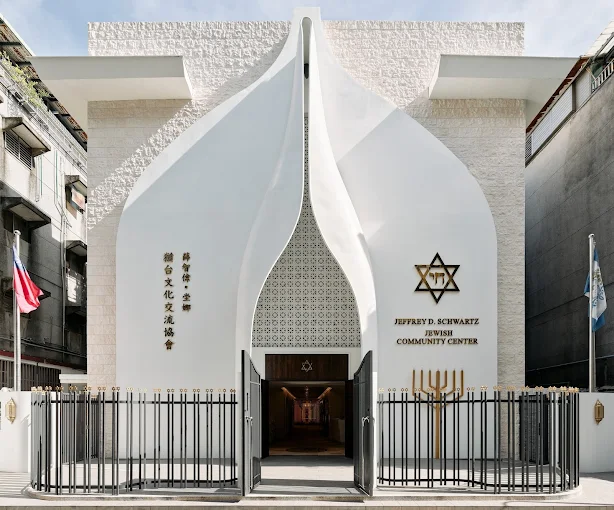
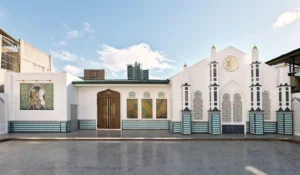
According to the JTCA fancy brochure, its front view looks like suggests something between the Taj Mahal and Like a dazzling white tallit wrapping the entrance door. The facade is adorned with a golden Star of David, one encasing the word Chai, beneath it the inscription: JEFFREY D. SCHWARTZ JEWISH COMMUNITY CENTER, beneath which sits a golden menorah. On the left-hand side of the entrance, there is a Chinese inscription I could not read. The wall behind is made of Jerusalem stones bricks.
A mosaic star of David glitters on the entrance floor, as if you are stepping directly into a constellation.
Step inside, and you are carried to Europe—or, more precisely, to the spirit of Europe’s great synagogues. The ark doors are carved wood, without a Parochet. The Bimah gilded.
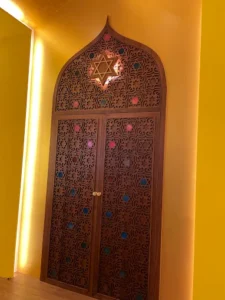
Above, the ceiling curves like a wave of gold—whether painted or simply lit to brilliance, it seems to shimmer with prayers already whispered.

The women’s section is separated by polished wood of the same design. Above the women’s section is a vaulted ceiling, on whose beams hang large golden letters from the Chanukka dreidel: Nun, Gimel, Hei, Shin.
Every Shabbat, the synagogue fills with 50 to 70 worshippers: half locals, half visitors. On Passover and the High Holidays of Rosh HaShanna and Yom Kipur, as many as 300 voices rise together, their prayers threading upward into Taipei’s humid sky.

But this complex is more than a place of worship. It is a world of its own. There is a gourmet kosher kitchen, a ballroom-like dining hall that hosts weddings, bar mitzvahs, and community celebrations, under chandeliers shaped like Stars of David. The carpets are blue and thick with Stars of David. The windows shaped like an arch ending in a pointed tip in the Ottoman style. Every Shabbat free kiddush meals are served.
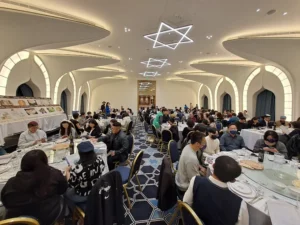
Even non-Jewish organizations rent the hall for events, savoring kosher meals while learning that these dietary laws, as Jeffrey explains, “It is a blessing to eat kosher food came from God.”
Israeli’s backpackers after army service, sometimes wander in, weary and hungry after Southeast Asian detours. For them, the JCC offers simple buffets at modest prices.
At the Jewish Center complex, there is also a Chabad House, managed by Rabbi Shlomi Tabib.
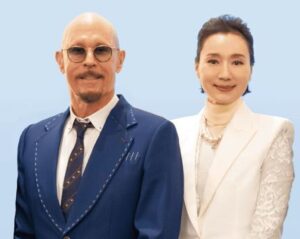
And then there is the museum. Jeffry Schwartz and his wife NaTang, the couple behind it all, is a collector of Judaica, and his treasures give the walls a soul. Every wall is decorated with ancient Jewish manuscripts, a glass cabinet containing Sephardic Torah scrolls, one of them a 600-year-old from Tunisia, a menorah, portraits of Jewish Nobel laureates.


A magnificent Iranian Chair of Elijah, inlaid with gemstones, waits patiently for each new Brit Milah ceremony.

Taiwanese schoolchildren come here to learn about Judaism, their eyes tracing Hebrew letters like unfamiliar constellations.
On the rooftop they have a beautiful terrace, music and laughter spill into the night. There they're installing the Chupa on weddings.
The mikveh is another wonder: railings and ceilings covered in gold, befitting a palace more than a ritual bath.

The story of this place, however, is inseparable from the story of Jeffry Schwartz himself. Born 74 years ago in Cleveland, he studied Chinese in Ohio State University and moved to Taiwan in 1972 because China was closed to foreigners. Over the decades, he built a business empire in exports, real estate, and finance. And then, in his seventies, he built this center, at a cost of $20 million, entirely from his own pocket.
“I've been in Taiwan for so long" he says. "Taiwan has been very good to us over all these years. I wanted to do something for Taiwan. My wife said to me I've been in business and raised my family. Now you're older, you should do something for Taiwan. I first replied: I already pay so many taxes. But I thought about it. What can I do that's different from any of the Chinese people?. So I decided to build a Jewish center".
I asked why a small community of 2,000 Jews needs such a large complex?
"This building was way too big for the Jewish community. It started as a small project. Then Hashem kept telling me, bigger, better, bigger, better. It’s not about how big you are, but how strong you are".
He did not just build a center. He rediscovered his Judaism in the process. Once a Conservative Jew who had drifted away. “My mother used to call and remind me when it was Yom Kippur,” he admits. Today, he now wraps tefillin daily, and wearing a black kippah. Last week he even purchased a home in Jerusalem.
"There's nothing more important than staying connected to Hashem, especially as we get older. When you're younger, you have plenty of time to make mistakes. When you're older, you don't have time for mistakes."
The synagogue is Orthodox—a choice that stirred criticism from his Reform friends. “They said: You're not Orthodox. Why are you making it Orthodox, Jeffrey? Our wives can’t sit with us in services. You should be taking care of us".
"I told them: Even when we go out for a beer, your wives don’t sit with us. Why should it be different in synagogue?"
But now, over time, all levels of observance are still different of the diversified local Jewish Community, but our spirits are in harmony as Jews living in a foreign country. We welcome everyone to join in whatever aspect of the JCC that resonates to you.
Yet what Jeffrey has created is bigger than denominations. It is a meeting point, not just for Jews but for Taiwanese society at large. He founded the 'Jerusalem–Taipei Fund' with Mayor Moshe Leon, hosts Israeli politicians, and supports the 'Jerusalem Prayer Breakfast'. Soon, even AIPAC donors will cross the Pacific to stand beneath this golden roof.
Taiwan, Jeffry insists, is the least antisemitic country in the world. Just five minutes away from the JCC, a mosque serves some 700,000 Muslims, mostly Indonesian caregivers and construction workers. “They’re not extremists”, he says. Taiwan presents a compelling travel destination for Israelis, particularly now, as a dark cloud of antisemitism is settling over Europe, making it an increasingly unwelcoming destination for Israeli tourists.
From its glossy brochures and his own storytelling, the center seems almost mythical, shimmering with gold and possibility. But the truth is even more compelling: a synagogue planted like a seed of Jerusalem in the heart of Taipei, promising roots for generations of Jews yet to come.
I plan to fly and see it myself soon, to walk its golden halls, to hear the echoes of Shabbat songs rising over the noise of scooters and street vendors, and to come back to report. Because sometimes, the most unexpected corners of the world hide not only history—but the future.