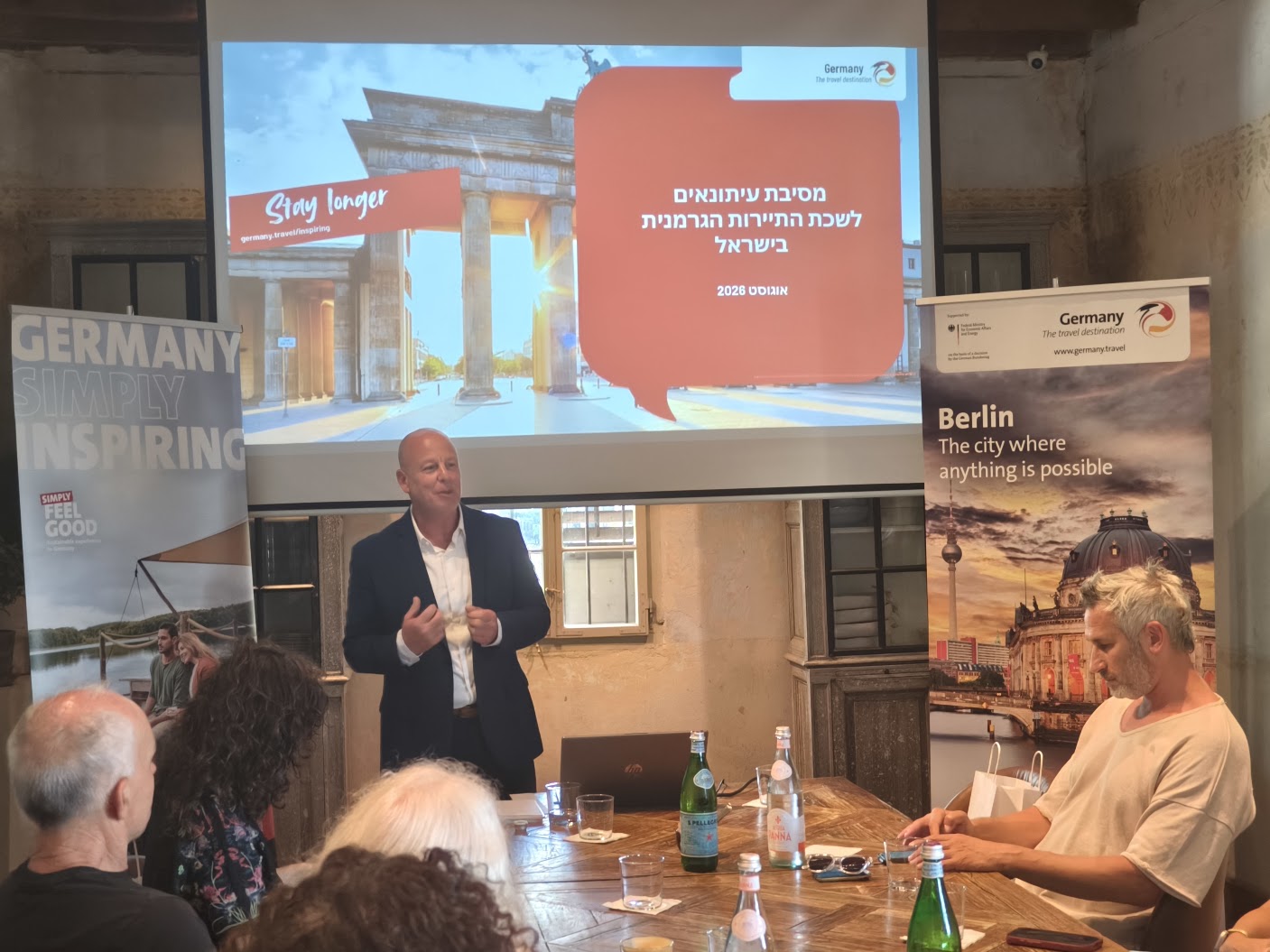
Germany's Tourism Office in Israel unveiled an ambitious 2026 campaign today, determined to replace the country's well-worn image of beer halls and bratwurst with something far richer: a destination where Michelin-starred dining, pristine landscapes, contemporary culture, and slow travel converge. It is an attempt not merely to promote Germany, but to persuade travelers to look at it with fresh eyes.
Speaking at the press conference, Ofer Kish, Director of the German Tourism Office in Israel, explained that for nearly two years the office had deliberately avoided promoting Germany. Without direct flights from Israel, marketing a destination would have been an exercise in futility.
That has changed. Airlines within the Lufthansa Group have resumed flights to Israel, while Condor inaugurated its Frankfurt route today. With air links returning, Israeli demand is steadily climbing once again.
Israeli Tourism Rebounds
In 2025, Israelis recorded approximately 685,000 overnight stays in Germany, an increase of 11 percent over the previous year. The figures suggest not only a recovery after an exceptionally difficult period, but also something more encouraging: travelers who return to Germany again and again, discovering that one journey rarely exhausts what the country has to offer.
Accommodation remains remarkably affordable by Western European standards. The average hotel stay costs around €106 per night, noticeably less than comparable hotels in France, Italy, or Spain. Tourism officials believe that without the disruptions caused by regional security concerns and interrupted flight schedules, those numbers would almost certainly have been higher.
Beyond Sausages: Germany's Culinary Renaissance
Germany has quietly transformed itself into one of Europe's gastronomic heavyweights.
Today it boasts 341 Michelin-starred restaurants, including twelve awarded the coveted three-star distinction, the highest honor the Michelin Guide can bestow. For Orthodox Jewish travelers, many of these establishments may remain beyond practical reach, simce they aren't kosher. Yet Germany's culinary appeal extends far beyond elite dining rooms.
The tourism board highlighted a collection of food routes that invite visitors to taste landscapes rather than menus.
There is the celebrated White Asparagus Route, through fertile countryside where the prized vegetable is treated with near-religious devotion. Cyclists can follow trails through the UNESCO-protected Spreewald Biosphere Reserve, famous for its centuries-old tradition of pickled cucumbers. Northern Germany offers festivals devoted to cabbage, while wine regions celebrate the arrival of Federweißer, the young, lightly fermented wine that signals autumn's first harvest. Along the Baltic and North Sea coasts, tasting journeys weave together fresh seafood, local produce, and villages shaped by salt winds and maritime traditions.
It is culinary tourism measured less in recipes than in landscapes.
Nature as Luxury
Food may tempt travelers, but Germany's newest campaign places nature at its heart.
Under the banner Family & Friends in Nature, the country is promoting dozens of national parks, protected landscapes, UNESCO World Heritage Sites, hiking trails, and cycling routes.
The accommodations themselves have become part of the experience.
Luxury treehouse hotels overlooking the Baltic Sea now allow guests to wake among pine branches while hearing waves rolling onto the shore below. A newly opened forest retreat promises complete immersion inside a private woodland. Meanwhile, nearly fifty islands scattered between the Baltic and the North Sea offer an appealing combination of quiet villages, regional cuisine, and wide horizons where the sky seems to occupy more space than the land itself.
Germany appears increasingly interested in slowing visitors down rather than rushing them between attractions.
A Remarkable Cultural Calendar
The coming year also promises an exceptional cultural program.
Dessau will commemorate the centenary of the Bauhaus movement through international exhibitions and celebrations. Frankfurt has been named World Design Capital. Nuremberg's Documentation Center will reopen after an extensive renovation. The legendary Bayreuth Wagner Festival marks its 150th anniversary, while Hamburg prepares to unveil a new museum dedicated to digital art.
It is an impressive calendar, carefully designed to present Germany not only as the custodian of history but as a country continuously reinventing itself.
The Silence That Echoed Loudest
Yet amid all the discussion of Michelin stars, cycling trails, forests, architecture, and design, one omission became impossible to ignore.
The official presentation did not devote a single word to Germany's Jewish heritage.
For many Israelis, Germany still evokes the darkest chapters of the twentieth century. Some refuse to set foot on German soil because of the Holocaust, making the destination uniquely difficult to market.
But memory is rarely one-dimensional.
Long before the Third Reich, Jewish civilization flourished in German lands for nearly a thousand years. Its scholars shaped religious thought, its communities became intellectual centers, and its rabbis left an influence that continues to resonate throughout Jewish life today.
That remarkable story remained absent.
Berlin appeared only in connection with the renovation of the Pergamon Museum and a 260-kilometer cycling route inspired by pickled cucumber traditions. Frankfurt was presented through cider orchards and bicycle trails. Yet there was no mention of the UNESCO-listed ShUM communities of Speyer, Worms, and Mainz, the medieval heart of Ashkenazi Judaism. These were the academies where Rashi himself pursued advanced Torah study. Here lived Rabbeinu Gershom, the "Light of the Exile," whose tomb continues to attract Jewish pilgrims from around the world. The celebrated Takkanot ShUM, formulated by these communities, profoundly influenced Jewish law and remain woven into large sections of the Shulchan Aruch observed today.
Hamburg told a similar story.
The city's spectacular Elbphilharmonie concert hall and forthcoming Museum of Digital Art received generous attention. Yet the Albert Ballin Emigration Museum, together with the legacy of towering rabbinic figures such as Rabbi Jonathan Eybeschütz and Rabbi Jacob Emden, passed without acknowledgment.
The pattern extends far beyond individual cities.
For centuries, prosperous Jewish communities flourished along the Rhine, producing generations of scholars whose influence reached every corner of the Jewish world.
For Israeli travelers, Germany possesses the ingredients for something approaching a journey through ancestral memory. It is, in many respects, sitting atop a gold mine of Jewish heritage tourism. Countries such as Hungary and Italy actively showcase comparable Jewish landmarks as integral parts of their tourism identities.
Germany, curiously, does not.
An Opportunity Still Waiting
When asked directly why Jewish heritage had been excluded from both the presentation and the broader marketing strategy, Ofer Kish offered a cautiously optimistic response: "Next year I will try to secure a budget for promoting the ShUM communities and other Jewish heritage sites."
It was an encouraging answer, suggesting that the omission was not ideological but practical.
Still, it also acknowledged an uncomfortable reality.
Germany is investing enormous effort in telling a new story about itself, one of gastronomy, forests, architecture, design, and sustainability. All of those chapters deserve attention.
But perhaps its most compelling narrative, especially for Israeli visitors, has yet to be fully embraced.
"A Country That Surprises You Every Time"
Kish concluded the event by describing Germany as a nation undergoing what he called a tourism revolution.
Every visit, he argued, reveals another facet of the country, whether through world-class restaurants, untouched landscapes, or international cultural festivals.
He believes Germany will become one of the Israeli market's most sought-after destinations during the coming year.
He may well be right.
Yet Germany's greatest competitive advantage for Israeli travelers may not lie only in its Michelin stars, forest retreats, or design festivals.
It may lie in the thousand years of Jewish history that unfolded long before the catastrophe of the Holocaust, a chapter still waiting to become an integral part of the story Germany tells the world.