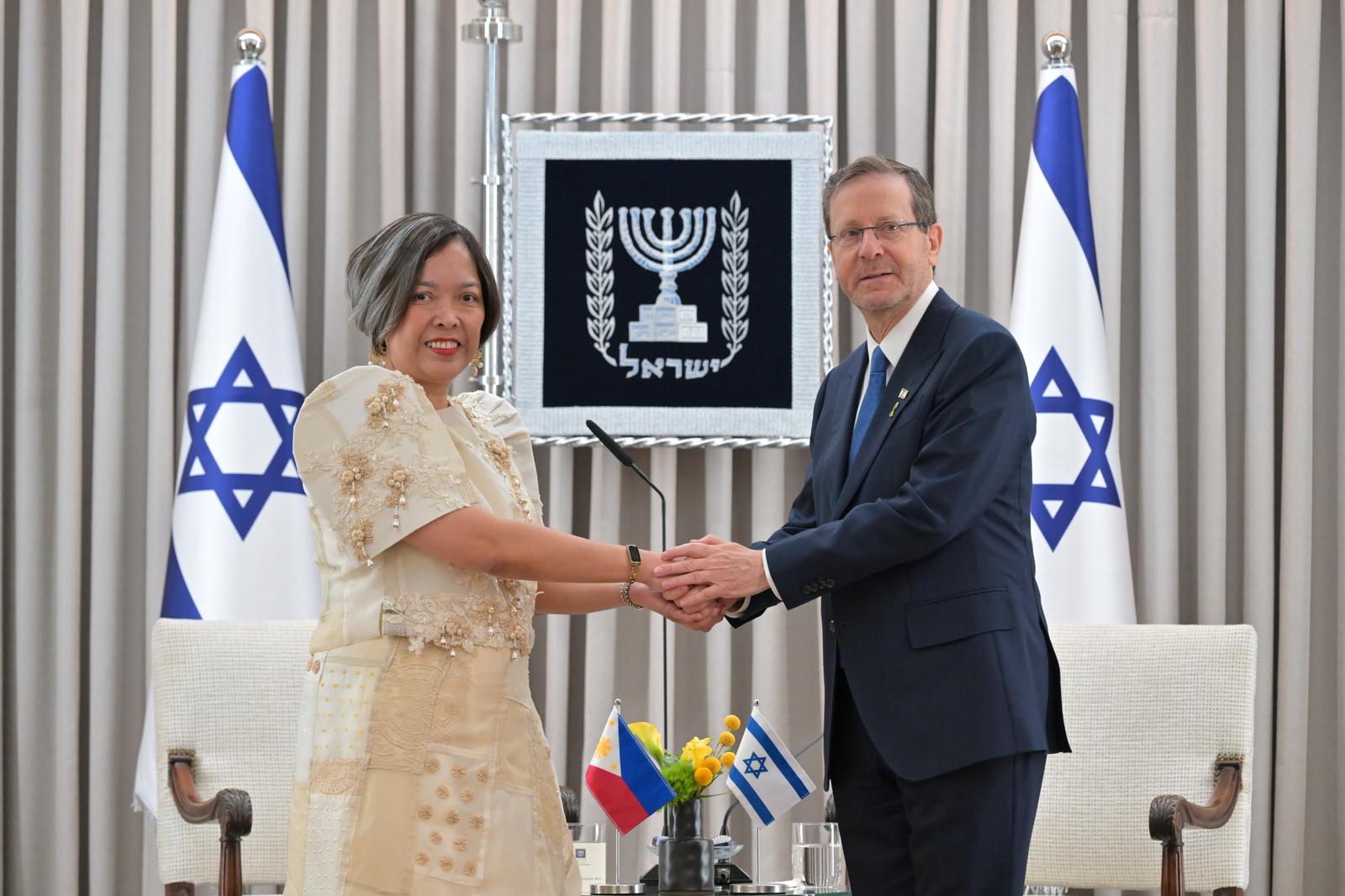
Just two months ago, a new ambassador of the Philippines arrived in Israel to begin her diplomatic mission. Mrs. Aileen S. Mendiola has since stepped into her role with grace and curiosity. I had the pleasure of sitting down with Ambassador Mendiola for her first official media interview in Israel.
Q: Madam Ambassador, welcome to Israel! How have your first few weeks been?
Ambassador Mendiola: "I’ve been here for nearly two months, and I still feel like a tourist. Every morning reveals something new-signs along the roads, landscapes, or historical markers that I photograph and send to my family and friends back home in the Philippines. What strikes me most is how every day in Israel feels like a deep dive into history. Living in the Holy Land, surrounded by Biblical heritage, is both humbling and enlightening".

Q: Israelis are eager to get to know you. Could you share a bit about yourself?
I’m an academic by training and have been in the diplomatic service since 1993. I’m 59 years old and entered the field at a young age. I studied history at university and specialized in Chinese culture, which led me to pursue further studies in both Taiwan and mainland China through a scholarship from the Philippine Foreign Ministry.
Over the years, I’ve held various posts. I served at the Philippine mission in China and worked at the Office of the President during the Ramos administration, where I gained invaluable experience. Later, I was posted in Singapore with a portfolio spanning economic, political, and cultural affairs. I then spent nine enriching years in Shanghai as Consul General, including overseeing the Philippine pavilion at the World Expo.
Following that, I was posted to Paris as Deputy Ambassador and focused on political and security issues, as well as representing the Philippines at UNESCO. Before coming to Israel, I served as Director-General for the Asia-Pacific Region, managing our relations with 44 countries.
Q: What are your main goals and priorities during your tenure in Israel?
One of my top priorities is strengthening economic ties and fostering joint business ventures. I’m keen to encourage two-way investment: Israeli businesses entering the Philippine market, and Filipino enterprises exploring opportunities in Israel. I’m deeply impressed by Israeli innovation and technology, and I’m actively exploring ways to bring some of that expertise to the Philippines.
For instance, in preparation for Israel’s “Cyber Week” this June, I’ve helped organize a Philippine delegation. Israel’s advancements in agriculture also generate significant interest back home, and I aim to connect Israeli agritech firms with potential partners and clients in the Philippines.
Culturally, I’d love to see more artistic and historical exchange between our countries. One personal dream of mine is to bring the Dead Sea Scrolls to the Philippines for a museum exhibition. Beyond that, there’s an important piece of shared history I wish to highlight: during the Holocaust, when nearly every country closed its borders to Jewish refugees, the Philippines stood alone in opening its doors.
Under the leadership of President Manuel Quezon, thousands of Jewish refugees found safety in Manila. He even donated his private land to help them resettle. I hope to work with Yad Vashem to have him officially recognized as Righteous Among the Nations and to raise broader awareness of this remarkable act of humanity.

Jewish refugees in Manila celebrating Hanukkah 1943
And of course, tourism is another exciting frontier. I believe both Israelis and Filipinos have so much to discover and enjoy in each other’s countries.
Beyond these initiatives, I’m here to maintain and strengthen the already excellent diplomatic and political ties between our nations. Israel and the Philippines share a warm, respectful relationship, and I’m honored to help carry it forward.
Q: How would you describe the current state of bilateral relations between the Philippines and Israel?
Our relationship is warm and steady, anchored by a deep historical bond. The Philippines was the only Asian country to vote in favor of the establishment of the State of Israel at the United Nations in 1947, and we also provided refuge to Jewish survivors of the Holocaust. Today, we’re entering a new phase-focused on rebuilding our tourism profile and expanding cooperation in areas like agriculture, water management, and technology.
Q: How many Israeli tourists visit the Philippines annually?
Currently, we welcome around 20,000 Israeli visitors each year. Before the COVID pandemic, the numbers were significantly higher. My goal is not only to return to those levels but to surpass them. Israeli passport holders can enter the Philippines visa-free for up to 90 days, which we hope will encourage even more travel.

Q: Israelis are known for their love of Southeast Asia, yet relatively few visit the Philippines. For example, around 200,000 visit Thailand annually, compared to only about 20,000 who come to the Philippines. What accounts for this gap?
This disparity is something we’ve looked into seriously. One major factor is the absence of direct flights. Without that convenience, many travelers opt for more accessible and affordable destinations like Thailand or Vietnam. We’ve observed a similar pattern in several European countries as well.
Another reason, which is discussed less openly, is the subsidization provided by the Thai government to its tourism sector. Unfortunately, we currently don’t offer such subsidies in the Philippines.

Before arriving in Israel, I consulted with our Secretary of Tourism, Ms. Christina Garcia Frasco, who outlined our strategic priorities. The Philippines is currently investing heavily in promoting tourism in our target countries like Korea, Japan, China, India, Russia, and the United States. We’ve even opened dedicated tourism offices in those markets. In contrast, we don’t yet have a tourism bureau in Israel. Israeli operations fall under the purview of our London office.
Still, our embassy in Tel Aviv is working hard to bridge that gap. For example, I’ve initiated talks with leading Israeli travel agencies about launching charter flights to the Philippines. We’ve also organized a familiarization trip this September for Israeli tour operators. Once they’ve created suitable travel packages, we plan to host a delegation of Israeli travel writers, giving them concrete experiences to write about.
Our annual Lantern Festival draws global attention with its breathtaking artistry. I’m currently in discussions with the Jerusalem Municipality to bring some of these luminous works to the Jerusalem Festival of Light. We’re also planning a special Philippine visual installation to be projected onto the walls of the Old City, an inspiring cultural exchange between our nations.
Q: Are there plans to promote direct flights between Israel and the Philippines?
Absolutely. In 2023, my predecessor met with officials from our Ministries of Foreign Affairs and Tourism to advance discussions around launching direct flights between Tel Aviv and Manila, ideally starting in 2024. Right now, we’re exploring the feasibility of charter flights as an initial step before moving on to regular scheduled service.
Q: Have any concrete steps been taken?
Yes, there’s real momentum. The Israeli Ministry of Tourism and relevant agencies in the Philippines are currently assessing market demand, not only from leisure travelers but also pilgrims and businesspeople. The ultimate goal is to establish regular direct flights, most likely through Philippine Airlines. In fact, they had already planned a Tel Aviv-Manila route in 2022 and had begun selling tickets on their website, but the launch was postponed due to regional security concerns.
At the moment, most Israeli travelers to Manila fly via Emirates through Dubai or Ethiopian Airlines through Addis Ababa. I’ve met with their local representatives-Tal Aviation and Ephraim Fortis of OpenSky-to discuss more convenient connection times and possible charter flight arrangements.
Q: What tourist experiences in the Philippines would you most recommend to Israeli travelers?
The Philippines is an untouched gem waiting to be explored. We offer pristine beaches like El Nido, Siargao, and Boracay, each one a postcard-perfect paradise. Then there’s the dramatic volcanic landscape and vast countryside of the Bicol region, with opportunities for adventure: colorful coral diving, hiking around active volcanoes, and exploring lush, hidden forest trails.

Mayon Volcano in Albay, Bicol
Beyond nature, we also offer cultural treasures, particularly in off-the-beaten-path destinations like the Batanes Islands in the far north, where local traditions remain beautifully preserved. It’s a destination that offers not just a vacation, but an experience rich in authenticity, adventure, and soul.
Q: Are there any Jewish heritage sites in the Philippines?
Absolutely! More than in many other Asian countries.
- In Quezon City, now a suburb of Manila, stands a tall memorial honoring President Manuel Quezon, who opened the doors of the Philippines to Jewish refugees fleeing the Holocaust. Beside it is a commemorative plaque dedicated to those refugees. We even offer a guided walking tour tracing this unique story of remembrance.

- Quezon Memorial
- Another historical site is the Marikina House-a private residence once owned by President Quezon, which he generously offered as a shelter for Jewish refugees. Today, the building serves as a school, but history enthusiasts can still view it from the outside.
- The present-day Jewish community is based in Makati, one of Manila’s modern districts. There you’ll find a beautifully maintained synagogue, a kosher restaurant, youth centers, and adult programs. Smaller Jewish communities still exist in Cebu and Davao.
- Manila is also home to a Jewish cemetery, the final resting place of several Holocaust refugees who quite literally found refuge in Philippine soil. Around 70 Jews from Manila perished during World War II; a memorial at the cemetery entrance lists their names.
- At the American military cemetery in Manila, you'll also find Jewish soldiers' graves marked with the Star of David.
Guided tours of Manila’s historic cemeteries, including the Jewish cemetery, are available to the general public and have become a point of interest for history-focused visitors.
Q: Is the Jewish cemetery being promoted as a tourist site for Israeli travelers?
That’s a question best directed to Boaz Waxman, the Honorary Consul of the Philippines in Israel and owner of Ophir Tours.
Q: How do you accommodate the needs of religious Jewish travelers, such as kosher food and Shabbat observance?
We’re well-prepared. We've developed kosher solutions and created a “Shabbat Friendly” training program specifically for hotel managers.

The serene interior of the synagogue at Manila’s Jewish Community Center offers a quiet space for prayer and reflection
Rabbi Rafael Nirman from Netanya currently serves as the kosher supervisor in Manila. He certifies several food production facilities across the Philippines, and provides kosher meals to Philippine Airlines passengers. These meals can be ordered in advance for Jewish travelers and are delivered in sealed containers.
We also work closely with the Jewish community in Makati, where kosher kitchens and synagogues are available.

The Chabad House in Manila was inspired by the Rebbe’s house in Brooklyn
Additionally, there are five Chabad Houses located in the Philippines’ top tourist spots among Israelis. They offer kosher dining, prayer services, and even deliver catering to nearby hotels.

The Chabad House in Boracay
We are actively building relationships with religious travel agencies in Israel to provide Shabbat-friendly itineraries and kosher catering. This allows observant Jewish tourists to experience the Philippines’ adventure and beauty without compromising their religious values.
Q: A few years ago, the Philippine Department of Tourism launched a Hebrew-language website to showcase the country’s attractions. Is it still active? How do you plan to maintain it?
The website was originally created and managed by our Israeli PR consultant, Golan Yossifon. Unfortunately, we had to end our formal collaboration due to budget limitations. Since then, he has been maintaining the site voluntarily. I’ll need to check if it’s still being actively updated.
Q: In Israel, there is deep appreciation for President Manuel Quezon, who saved Jewish refugees during the Holocaust. How do you plan to promote his legacy among the Israeli public?
While President Quezon has been recognized locally, there is still a need to create meaningful, tangible connections through tourism and public engagement. We are exploring several initiatives to bring his legacy to life:
- “Quezon Day” at the embassy - a day dedicated to community activities such as sports events and the screening of a dramatized documentary film about President Quezon’s humanitarian efforts.
- Educational programs in schools - including presentations, lectures, and interactive sessions to introduce students to this inspiring chapter of history.
- A potential Quezon Museum - following the recent inauguration of the Quezon Memorial in Rishon LeZion, we are considering the establishment of a museum that would feature stories and artifacts from that era, deepening public understanding and engagement.

- Quezon memorial in Rishon LeTzion, Israel
Q: Are there commemorative sites for Quezon in the Philippines?
Absolutely. Quezon City, a major suburb of Manila, is a vibrant cultural hub that remains largely undiscovered by Israeli travelers. It is home to Quezon University, a blend of colonial and modern museums, and public parks that celebrate the life and legacy of President Quezon.
Q: There is a large Filipino workforce in Israel. What role does the embassy play in supporting this community?
The Filipino community in Israel primarily consists of caregivers for the elderly and housekeeping staff in hotels. They form what we often refer to as a “people’s embassy”- serving as daily ambassadors through their work, interactions, and cultural presence.
Much of the community's life revolves around local Christian churches, which play a central role in mutual support, visiting the sick- is a cherished tradition in Filipino culture. Information about community members who are hospitalized or unwell often reaches our consulate, allowing us to coordinate visits and offer support through the community network.
The embassy also steps in during times of crisis, helping to resolve both personal and social challenges. Like other Philippine embassies around the world, we provide access to welfare programs, legal assistance, and organize community gatherings that foster solidarity and joy.
In conclusion, the new ambassador brings a wealth of diplomatic experience, a deep commitment to strengthening ties between our nations, and great respect for Israeli Jewish travelers. Beyond advancing tourism through direct flights and heritage trails, there is a unique opportunity to foster deeper cultural understanding and human connection. I am confident that more and more Israelis will soon discover the warmth and richness the Philippines has to offer.