The Red Village (Krasnaya Sloboda) is a must-visit destination for Jewish Travelers. It is the only place in the world outside Israel whose entire population is Jewish. That fact alone is enough to draw Israeli travelers here, but there is far more beyond it.
A Story of Decline and Longing
In the 19th century, some 18,000 Jews lived here. A vibrant community rich in tradition. But the Soviet era slowly extinguished that spirit. Stalin exiled all the rabbis to Siberia and closed all the synagogues. And yet, unlike Jews in most parts of Russia who assimilated, the Jews of the Caucasus Mountains succeeded in preserving Judaism and Shabbat.
After the collapse of the Soviet Union in the 1990s, the exodus from the village began. Most emigrated to Israel; others went to Moscow in search of economic opportunity. The town was nearly emptied, and today the community numbers about 3,500 people. Mostly elderly, especially widows. Nearly every resident has family in Israel.

Between the empty houses, a luxurious villa sometimes appears, built by someone who succeeded in business in Moscow, but whose heart remained here among the red stones.

In the Red Village, there is a custom known as the “General Kaddish Day” on Tisha B’Av. On this day, sons and daughters return to the village to weep together over the destruction of the Temple, and to pray at the graves of their parents and relatives. It is a unique tradition. A kind of emotional bridge between a nearly vanished community and its descendants around the world.
Today the place looks like a deserted ghost town. From time to time, an old Lada car passes through the street. One hardly sees people outside. Only cats, and even they are in no hurry. Children are rarely seen, even though there are now two schools, a high school, a yeshiva, and even a Bnei Akiva youth movement branch. Many abandoned houses stand closed, neither rented nor sold to non-Jews. In a strange way, religious law preserved the Jewish uniqueness of the place.
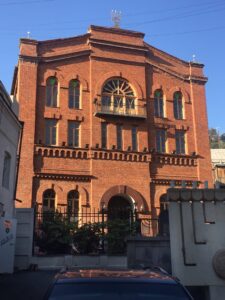
During Soviet times, the area was called “Yevreyskaya Sloboda,” the Jewish settlement. The name “Red Village” stuck because many of the first houses were built from red brick quarried from the surrounding mountains. Even those that later received plaster were repainted red. In every home one can find a small patio, an inner courtyard originally intended for building a kosher sukkah.
The Legend That Began on the Riverbank
There is a local legend about the founding of the village. On one Shabbat in 1734, the Persian army under the command of Nader Shah invaded another town in the region. The Persian soldiers also burst into the synagogue while the Jews were praying Shacharit. Rabbi Reuven ben Shmuel rose from his place and stepped toward the soldiers. The general raised his sword to strike the rabbi. Instinctively, to protect himself, the rabbi thrust forward the prayer book he was holding. Miraculously, the sword broke, and the prayer book was partially cut, but the rabbi was unharmed. The Muslim general saw this as a sign from Heaven. He said to the rabbi, “If your religion protects you so powerfully, I have nothing to do here.”
The original “slashed siddur” is now displayed in the local Jewish museum.
The attack was halted, and the Persian soldiers prepared to withdraw from the village. The general asked the rabbi what his request might be. The rabbi replied that the community wanted a more spacious place to live. The general granted him land on the southern bank of the Gudyalchai River, which became known as “the Caucasian Jordan.” Rabbi Reuven and his community settled there. About 30 years later, the ruler of Quba, Fath Ali Khan, invited more Jews to settle in that area.
The community expanded, and in the 18th and 19th centuries, it already included nine neighborhoods (“makhlot”), each named after the hometown of its residents. Every neighborhood had a synagogue, a mikveh, and communal institutions. The Jewish village expanded and became the spiritual and material center for all Jews of the Caucasus. It had yeshivot and a central rabbinical Beyt Din (Jewish court), earning it the title “Jerusalem of the Caucasus.”
The villagers engaged in trade, tobacco cultivation, and wine production. The local Muslims, who do not drink wine, allowed the Jews to develop the industry almost exclusively. The women of the village specialized in carpet weaving.
Last year, celebrations marking the 290th anniversary of the town were held in Tel Aviv, attended by Azerbaijan’s ambassador to Israel, Mukhtar Mammadov, and the head of the Azerbaijani Tourism Office in Israel, Jamila Talibzadeh.
Deep History: From the Tribe of Ephraim to the Quzars
How did the Jews arrive here?
Some researchers claim they are descendants of the Tribe of Ephraim, exiled from the Land of Israel to Persia at the destruction of the First Temple, and from there migrated here.
Another theory links them to the Qazar Kingdom. The Qazar empire ruled this region between 650 and 969 CE. The Jews of the region came to be known as “Mountain Jews,” because in the past they lived near Mount Shahdag, one of the peaks of the Greater Caucasus range, located about a half-hour’s drive from the Red Village. The mountain was the heart of the Quzar Kingdom. The city of Qusar is still located near the mountain.
We all studied the book The Kuzari, written by Rabbi Judah Halevi, which describes conversations between Rabbi Hisdai ibn Shaprut and the King of the Quzars, culminating in the king’s conversion to Judaism in 740 CE. He then ordered all his people to convert to Judaism. After several generations, another king came to power in Quzar who Islamized all the inhabitants. His control over the empire’s periphery was weak, and pockets of Jewish resistance refused to convert to Islam. The Jews of the Red Village are descendants of those Jews.
The Mountain Jews are called “Juhuro,” and they speak the Juhuri language. A Jewish dialect of Persian, just as Yiddish is a dialect of German and Ladino is a dialect of Spanish.
Thirteen Synagogues, Two Still Active
In the past, 13 synagogues operated in the Red Village. Today, only two are active. The others have become public buildings, schools, museums, all still marked with marble plaques in Hebrew on their entrance walls.

The Gilaki Synagogue was built in 1896 and has operated continuously ever since. It was never closed, not even during the Soviet period. The synagogue has 12 windows, symbolizing the 12 tribes of Israel. On the roof stands a low hexagonal tower, topped by a flat dome crowned with a Star of David. Inside the tower, whose walls are transparent, stands a seven-branched menorah.
Inside, the Torah-reading bimah stands beneath the raised dome. The furnishings are extremely ornate, with magnificent wood carvings above the ark, around the windows, and on the ceiling, truly awe-inspiring. Among the young people of the town who moved to Moscow are three who became wealthy oligarchs, yet did not forget their roots. They invested in the splendor of the active synagogues and other public institutions in the town where they grew up.

After the initial admiration of the woodcarvings and grandeur, I feel a certain absence. I do not see a women’s section.
I ask the Gabay (synagogue caretaker), Pesach ben David Isakov, “I see prayer books of Yahaveh Da’at, but are you affiliated with the Conservative movement?”
“No! Heaven forbid,” he replies.
“Then where is your women’s section? From here it looks as though women sit and pray together with the men.”
“No,” the caretaker replies. “Juhuri women do not come to the synagogue. Only on Yom Kippur and rare occasions do they come and stand in the courtyard outside, listening to the cantor through the windows.”

On the inner wall near the entrance we see an open cabinet with shelves holding woolen slippers. The local custom is to remove shoes upon entering. The caretaker explains that this is out of respect for the sacred place, similar to the Muslim custom when entering mosques. One of the worshippers tells me it is also to protect the expensive carpets (about 10,000 shekels each) that cover the floor.

The caretaker says that about 30 people pray in this synagogue daily, and on holidays it is full.
This synagogue was designed by the Jewish architect Hillel ben Chaim, whose name appears on other synagogues and public buildings he designed in the Red Village.
The “Six Domes” Synagogue

A few minutes’ walk brings us to the impressive architecture of the large “Six Domes” synagogue. Six domes stand on its roof, arranged so that the lines between them form the shape of a Star of David.

During the Soviet era, the building served as a warehouse. In the early 2000s it was returned to the community. Here too, the furnishings and the design of the Holy Ark are breathtaking in their splendor. There are two adjacent Holy Arks, commemorating the two Tablets of the Covenant.

A special prayer rite, “the Caucasian nusach,” is used here. Today, prayers are held here only during the warm seasons, as there is no budget to heat the large prayer hall.


The caretaker, Pesach ben David Isakov, says the synagogue has 120 seats, and during the High Holidays it is completely full, with worshippers even sitting on the floor in the aisles. A scene reminiscent of other times. Here too, there is no women’s section.
The Jewish Museum

In the Karchag Synagogue, a charming museum of Caucasian Jewry has been established. It has not yet officially opened, but we are allowed to visit nonetheless. The building had been abandoned and on the verge of collapse. It was carefully dismantled and rebuilt using the original stones. The renovation preserved the sanctified atmosphere, with traditional elements such as the bimah and Holy Ark, while adapting it into a museum.
In the entrance hall there are benches like those in a synagogue, with computer screens on the back of the seat in front of you, like airplane seats. Visitors can browse the digital information that interests them. The explanations on the screens and the wall signage are in Azerbaijani, Russian, and English. Why not in Hebrew too?

This museum is a living testament to the community’s heritage and a must-see destination, even though it has not yet officially opened. The museum was completed in 2019, but its inauguration ceremony was postponed due to the Covid19 pandemic and recently postponed again because of the war in Gaza.


Among the exhibits are traditional garments, ritual objects, jewelry, manuscripts, and sacred items through which Judaism is presented. I also saw a fascinating exhibit there- a pair of tiny tefillin, only about a centimeter and a half wide, resembling dice. The guide, Elnara Gadashova, explains that during the Soviet period, Jews laid tefillin in secret and had to hide them under a hat or inside a shirt sleeve. Therefore, in Russia at that time, tefillin cases were produced in such small sizes.

One of the most interesting documents on display is a handwritten letter describing the Jews’ migration to the Caucasus, comparing it to the story of the Exodus from Egypt. How their ancestors fled Persia, wandered through deserts, crossed rivers and mountains, until they reached “the land of mountains that touch the sky, where they built the House of God,” in a neighborhood called Gilaki, named after their hometown in Persia.
In the Red Village, a local newspaper called Birlik-Yedinstvo (Unity) is published in Russian and Azerbaijani. The Jewish museum also displays copies of the newspaper in the Azerbaijani language printed in Hebrew letters. The Red Village also had a Jewish theater and singing ensembles.

A source of local pride is a massive carpet covering 70 square meters, woven in 1949 in honor of Stalin’s 70th birthday. A group of 70 people worked day and night, weaving 90,000 knots a day. After eight months, the carpet was completed, featuring a four-meter-tall portrait of Stalin at its center.
The exhibition also includes photographs of famous Jews from the Red Village. Among them, we found a photo of Israeli singer Yaffa Yarkoni, whose origins are from the village, and of Major General Yekutiel Adam, whose parents were born here, and who was killed in the Lebanon War just a few meters in front of me.

A place of honor is dedicated to Azerbaijan’s national hero, Albert Agarunov, who grew up in the Red Village. During the Nagorno-Karabakh War in 1992, he was a revered tank commander. The Armenians attempted to assassinate him unsuccessfully. Once, they placed the bodies of dead soldiers on the road along which Agarunov was driving, knowing that as a religious Jew, he would respect the dead and not run over the bodies. Indeed, Agarunov stopped the tank and descended to move the bodies, at which point an Armenian sniper shot and killed him.
The museum director is Igor Shaulov, and the chief guide is his deputy, Elnara Gadashova, who also speaks Hebrew.
The Mountain Jews did not suffer during the Holocaust, because the Germans declared that they were not Jews but part of the “Caucasian-speaking peoples.”
Walking Tour
When leaving the museum and a light breeze passes between the red bricks, we can notice Stars of David above the doors of many houses.


Some buildings that once served as synagogues still bear marble plaques with Hebrew inscriptions mentioning donors or the synagogue’s name.


For example, the green building that now serves as a pharmacy was once a synagogue.

Another interesting building on our walking tour is the maternity house, notable for its green color. The building was originally the private home of a wealthy, childless couple. After the husband was widowed, he no longer wished to live in a house filled with memories of his beloved wife. He renovated his home to serve as a maternity house. The exterior wall of the façade was designed in the Art Nouveau style, with supporting columns (caryatids) in the image of his wife, and above the windows mascaron sculptures of children’s and babies’ faces as decorative elements.


At the edge of the Red Village, over the Gudyalchai River, stretches the Arch Bridge. An engineering project of Tsar Alexander III that withstood floods. Today it is open only to pedestrians and closed to vehicles for fear of collapse. The bridge is also called the Bridge of Love, because on spring Saturdays and during the Nowruz holiday, the community observed their version of Tu B’Av there.

Jewish families would go on picnics along the riverbank near the bridge, and unmarried young women seeking a match would walk back and forth across the bridge in a kind of fashion parade. Young men would stand beside or beneath the bridge to watch the procession, and if a young woman caught a young man’s eye, his parents would contact her parents to arrange a marriage. Apparently, this matchmaking method worked, because the town’s wedding hall was built at the beginning of the bridge. Above its entrance we see a Star of David and an inscription in Russian. The last wedding held here took place last summer.

Zionism Emerges from the Caucasus
The Red Village had vibrant Zionist activity. Caucasian representatives from the region participated in the First Zionist Congress in Basel in 1897 and in subsequent congresses. In addition, Zionist congresses exclusively for Caucasian Jews were held, with delegates from the Red Village as well.
Their Zionism was not merely talk and debate, it was practical. The first wave of Aliyah from here to Israel occurred at the end of the 19th century. The Chief Rabbi of the Caucasus, Yaakov Yitzhak Yitzhaki, immigrated to the Land of Israel with hundreds of his community members, settling in Jerusalem’s Bukharan neighborhood. Later, Rabbi Yaakov purchased a large tract of land adjacent to Ness Ziona and established the settlement of Be’er Yaakov, named after him, which became a big city
Another wave of Aliyah occurred in the mid-1970s, when 12,000 Mountain Jews immigrated to Israel. With the collapse of the Soviet Union in the early 1990s, most of the residents of the Red Village made Aliyah.
The Jewish Cemetery

At the top of the hill lies the ancient cemetery. The earliest tombstone dates back to 1756. Most of the gravestones are made of black marble, engraved with portraits of the deceased. A unique tradition that adds a personal dimension. There are also family burial plots enclosed in marble, containing only a few graves.
It is also worth visiting the grave of Rabbi Gershon, who was the Chief Rabbi of Caucasian from 1853. Rabbi Gershon established the only Rabbinical Jewish Court in the entire Caucasus Mountains, and under his leadership, the town earned the title “Jerusalem of the Caucasus.” His grave was renovated in 2013.
In towns such as Oghuz and other villages in the north, there are additional Jewish heritage sites. I have not yet had the privilege of seeing them, but if you have already come this far, it is worthwhile to continue and discover more chapters of Jewish history that remain mysterious and hidden.
Between the red bricks, the flowing rivers, and the ancient gravestones, the Red Village remains a living testimony to a Jewish spirit that did not surrender, as if crying out “Am Israel Chay" (The People of Israel Live). It is a place where history touches the present, and faith, even as nearly the entire world has changed, continues to flow through generations and memories, like the mountains surrounding the village, touching the sky.