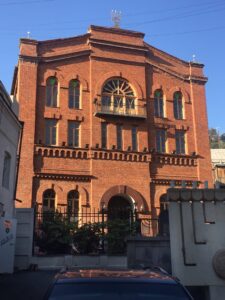
In Europe, thousands of synagogues can be found, many of them located near almost every destination. For those planning a trip to Europe, it is worthwhile to explore the website of the Foundation for Jewish Heritage: www.foundationforjewishheritage.com.
The foundation initiated and funded research by the Center for Jewish Art at the Hebrew University of Jerusalem, identifying 3,347 historic synagogues across 14 countries, all marked on a map. Of these, fewer than a quarter are still considered Jewish places of worship, and only a few are used for prayer. The majority serve other purposes or have been abandoned. The website’s “current use” category provides insights into its functions. For instance, it highlights synagogues converted into churches, museums, theatres, cinemas, restaurants, libraries, and even a swimming pool in Kraków. Synagogues can also be categorized by their current use, with an “abandoned” subcategory marking those awaiting preservation.
The site ranks each synagogue by its level of significance—local, regional, national, or international. Architecture enthusiasts can browse synagogues by construction materials—stone, brick, or wood. Each synagogue is also evaluated based on its current condition: good, deteriorating, or very poor. For example, a data review revealed that 160 highly significant synagogues are in a very poor state.

This website is an excellent tool for Jewish travellers planning their journeys, regardless of the destination. Clicking on any red dot representing a synagogue opens a detailed information screen. For example, clicking on a marker in Wales reveals a synagogue in Merthyr Tydfil, Wales, with photos depicting it as resembling a small castle.

Additional details include its construction date in the 1870s, its closure in 1983, and its subsequent sale when the Jewish community disbanded. Built from local stone in a Gothic style, it holds national significance but is in very poor condition. It was used as a fitness centre until 2006, and in 2019, the Foundation for Jewish Heritage purchased the building to transform it into a Jewish-Welsh cultural centre.

Welsh Synagogue Vision
The vision is to establish the synagogue as a cultural centre recounting the history of the Jewish community in Wales, which has been active for over 260 years. This £6 million national project is funded primarily by the UK National Lottery Heritage Fund and the Welsh government. In 2021, King Charles visited the site to inspect renovation progress. The website also provides directions to the synagogue.
The Foundation’s Mission

Based in London, the Foundation for Jewish Heritage is led by Founder and Chief Executive Michael Mail.
 Mail explains: "The synagogue research was conducted to identify and prioritize our work. Synagogues are the most iconic structures of Jewish communities and hold immense significance. Through this research, we’ve compiled a priority list of the most endangered synagogues, currently working on 18 sites. We focus on synagogues at risk in areas with small or non-existent Jewish communities, as significant communities typically maintain these buildings. We don’t usually own the properties but provide advice, guidance, and expertise to owners, volunteers, and municipal leaders aiming to preserve them."
Mail emphasizes: “These synagogues play an important role in modern society. They can share the Jewish story with broader communities, fostering knowledge, and understanding, and combating ignorance, prejudice, and antisemitism. We view these structures as ‘mini-embassies’ for the Jewish people. It’s not just about preserving old buildings—it’s about making a meaningful impact today. Using synagogues for these purposes is powerful because they are both local and authentic.”
Brighton Synagogue

One notable example is the Middle Street Synagogue in Brighton, England, built in 1875. A luxurious resort destination in the 19th century, Brighton attracted British and Jewish aristocracy, including the Rothschild and Montefiore families. Though no longer in use for regular prayers, the synagogue occasionally hosts weddings and bar mitzvahs. Its striking architecture, including an ornate Ark, remains a highlight. Plans are underway to transform it into a Jewish heritage centre showcasing the contributions of Brighton’s Jewish community. Mail states, “We’re exploring options for repurposing the building while preserving its beauty and historical significance.”
Jewish Cemeteries and Other Initiatives
Another major project involves mapping Jewish cemeteries in Moldova, Georgia, Ukraine, Lithuania, Poland, Hungary, and Slovakia. This initiative, in collaboration with the European Jewish Cemeteries Initiative (ESJF) and Centropa, raises awareness about Jewish cemeteries and integrates them into school curricula.
Additionally, the foundation mapped 368 Jewish heritage sites in Syria and Iraq. A project named “Moreshet” (Heritage) unites professionals across Europe to preserve Jewish heritage through training, collaboration and shared learning.
While the Foundation for Jewish Heritage has collaborated with Israel’s Center for Jewish Art, it does not yet have an Israeli office. Michael Mail is keen to involve Israeli volunteers in its projects in Romania, Spain, and Transylvania. Passionate individuals are encouraged to contact the foundation through its website.