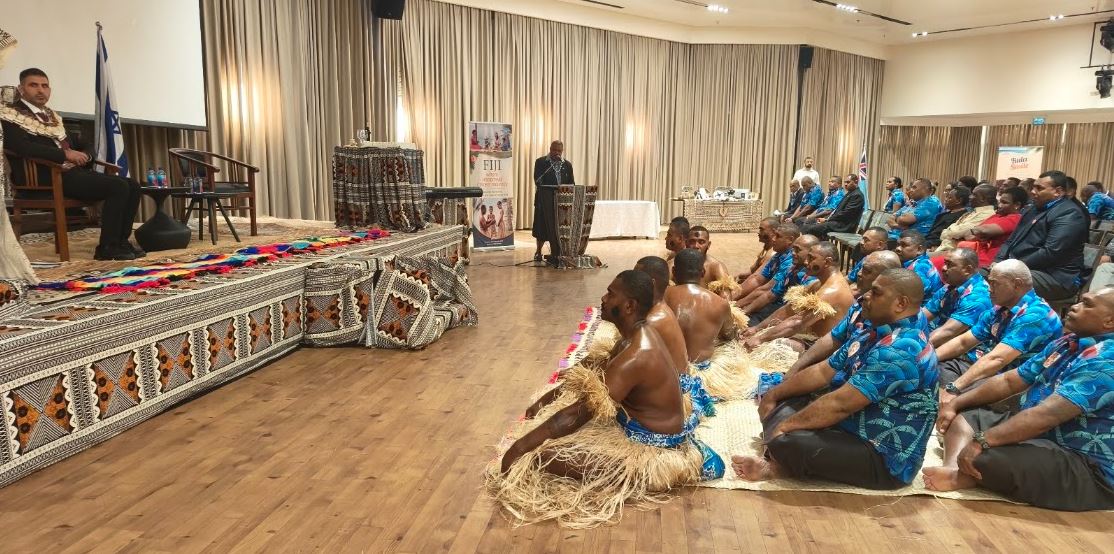
Fiji Independence Day was celebrated in Israel for the first time at an official reception hosted at the Vert Hotel in Jerusalem. The event brought together diplomatic ceremony, vibrant Pacific culture and friendship between two countries separated by thousands of kilometers. Fiji Independence Day in Jerusalem. Beyond the colorful costumes, traditional rituals and theatrical performances, however, the evening carried a clear message: Fiji wants to strengthen its ties with Israel, deepen bilateral cooperation and encourage Israelis to discover its islands.
Traditional Fijian Dress and Ceremonies
From the moment guests entered the hall, it was clear that this would not be an ordinary diplomatic reception, where handshakes, polite speeches and business cards usually take center stage. On the staircase leading down to the event hall stood two Fijian guards, bare-chested and dressed in skirts made of straw, each holding a traditional ceremonial weapon resembling a large club. Their presence offered a reminder that Fijian culture has a warrior past, long before the island nation became a fascinating destination in the Pacific Ocean.

More surprises awaited guests in the lobby. Several Fijian men wore dark, tailored suits, white shirts and bright red ties, but instead of trousers, they wore the traditional men's garment, a wraparound skirt known as a sulu. Some wore sandals, while others were barefoot. Among them was the ambassador himself, Jesoni Vitusagavulu, known as Vito, who incorporated traditional dress naturally into his diplomatic appearance.
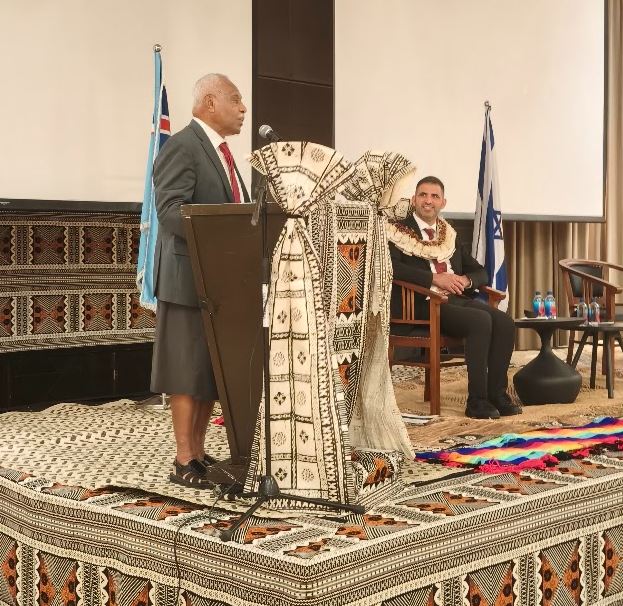
The scene was delightful precisely because nobody was trying to conceal the cultural differences. Western suits and traditional attire existed side by side without apology, demonstrating that diplomacy need not be uniform or colorless to be dignified.
The hall filled with Israeli guests, members of the diplomatic corps from foreign embassies, representatives of the Israeli government and Foreign Ministry, and a delegation from Fiji. The Israeli government was represented by Minister Shlomo Karhi.
Before the speeches began, a traditional ceremony was conducted in the Fijian language. Participants dressed in traditional clothing sat on the floor in front of the stage, listening to one of their own, who led the proceedings in a manner reminiscent of a cantor in a synagogue. His voice filled the room, and from time to time those gathered around him responded with rhythmic applause at certain points in his words. For most of the Israeli audience, the language remained unintelligible, but the body language, rhythm and shared participation communicated a meaning of their own.
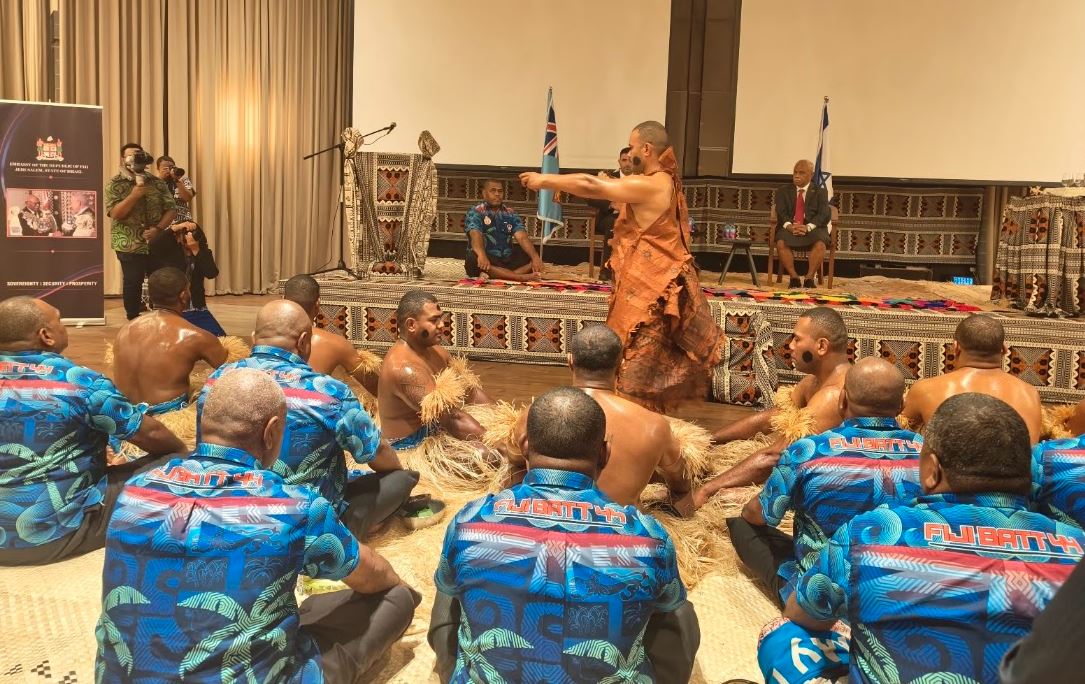
A large wooden bowl containing a traditional drink was then brought to the center of the circle. One of the participants mixed the drink by hand before it was poured into cups made from coconut shells and served to the distinguished guests, including the ambassador, the honorary consul Rafi Dayan, and Minister Karhi.
The ceremony gave the reception a dimension rarely seen at diplomatic gatherings in Israel. This was not simply a series of speeches about culture. Culture itself had entered the room and been given pride of place.
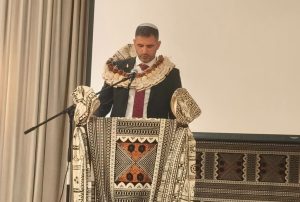
Another symbolic moment followed when a young Fijian woman approached Minister Karhi and draped a traditional Fijian ceremonial necklace (salusalu) around his neck and shoulders. The broad, multilayered adornment, combining pale layers with brown elements, stood out against his dark suit. It was both a festive decoration and a traditional way of welcoming an honored guest.
The Ambassador Seeks to Bring Fiji Closer to Israel
The highlight of the official proceedings was the speech by H.E.Ambassador Vitusagavulu. For him, the occasion carried special significance: it was the first time Fiji’s embassy in Israel had hosted an official reception to celebrate the country's Independence Day.
Fiji, an island nation in the Pacific Ocean, consists of 333 islands and has a population of fewer than one million people. This year's Independence Day celebrations were held under the theme "An Inclusive Fiji for a Better Tomorrow." The ambassador emphasized that multiculturalism and religious diversity are central to his country's identity, and that human diversity is a source of strength rather than an obstacle.
His message, however, was also political.
Fiji opened its embassy in Jerusalem in September 2025, a move the ambassador presented as an expression of the longstanding friendship between the two countries.
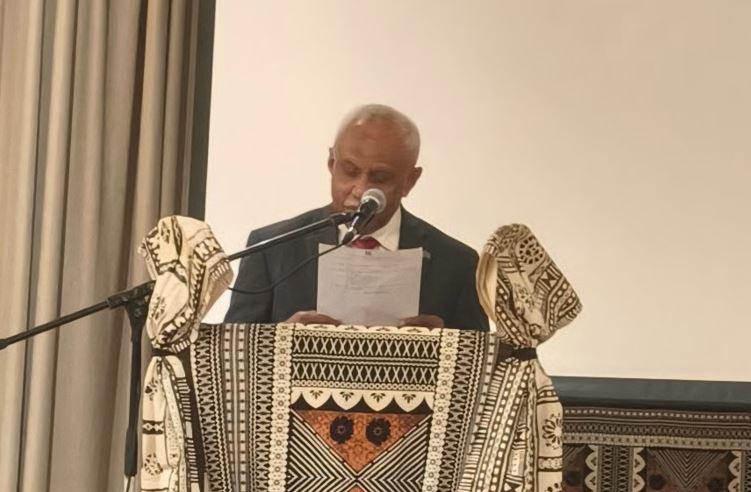
"Many have asked why Fiji chose to establish its embassy specifically in Jerusalem," Ambassador Vito said. "The answer is simple: we wanted to stand with Israel at a time when it is experiencing growing international isolation. We know what it feels like when a country finds itself isolated.
"In 1987, following political upheaval in Fiji, our country found itself isolated by much of the international community. At a time when others chose distance, Israel chose friendship. At a time when others chose isolation, Israel chose engagement. Israel sought to understand rather than condemn. The people of Fiji have never forgotten that.
"Today, we seek to extend the same hand of friendship. We believe dialogue achieves more than division, engagement achieves more than isolation. We believe understanding achieves more than condemnation.
"Our foreign policy is guided by a simple principle: friends to all, enemy to none. It makes us stand solidly with friends and at the same time grieve with all those who suffer from conflicts. And it inspires us to contribute to lasting peace.."
The ambassador incorporated several Fijian expressions into his speech, giving the audience a lighthearted moment when he translated one of them into the familiar Hebrew slang word "SABABA", meaning something like "great" or "excellent." The smiles around the room briefly broke the formal atmosphere and served as a reminder that even languages from very different worlds can contain words that bring people together.
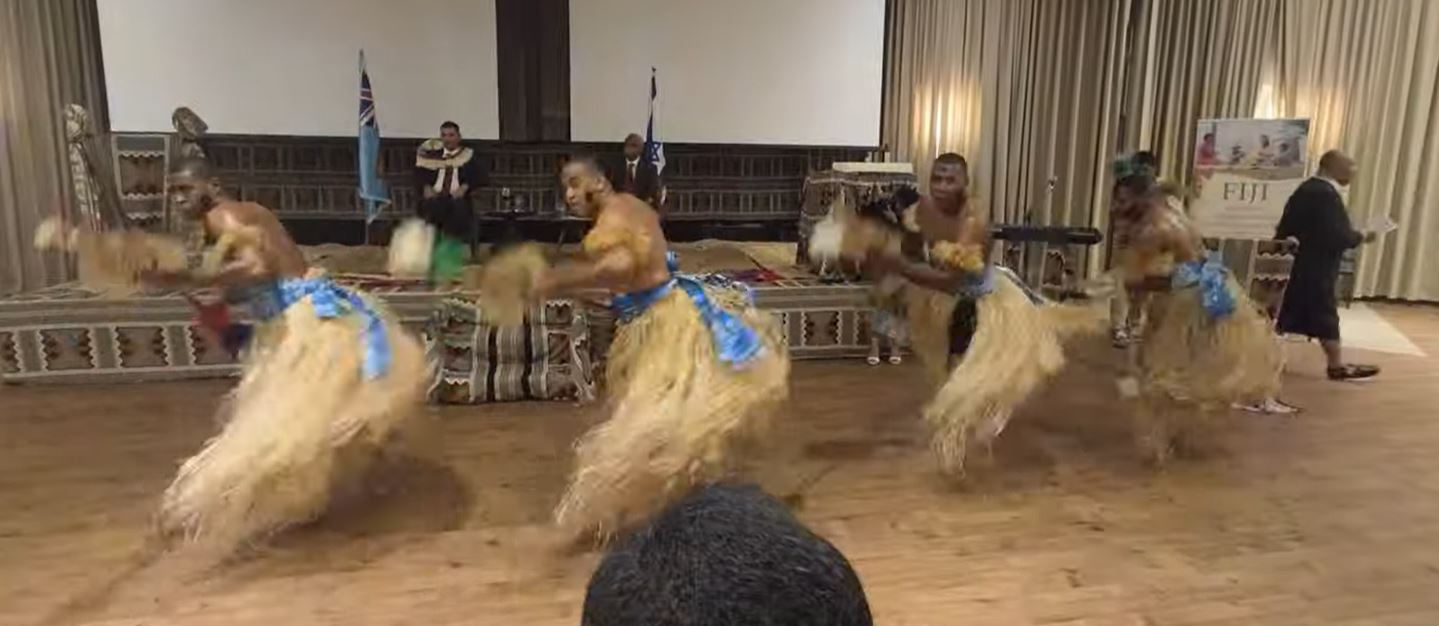
Vito also referred to Fiji's warrior past, which guests had encountered at the entrance, and to the traditional war dances scheduled for later in the evening. He explained that Fiji had long since moved away from its bellicose past and had spent nearly five decades contributing to peacekeeping efforts. Fijian soldiers serve in United Nations missions, including in the Golan Heights, Lebanon and Sinai.
Tourism to Fiji Takes Center Stage
One of the most interesting parts of the ambassador's speech concerned trade and tourism development.
"We are also working to encourage Israeli investment and establish partnerships in agricultural technology. We are working to create export opportunities as well.
"At the same time, we are working to increase the number of Israeli tourists visiting Fiji. There is no better way to discover Fiji and appreciate its beauty than to visit and experience it for yourselves. Recently, we successfully hosted an online seminar entitled 'Discover Fiji,' attended by Israeli travel agents association (ITTAA)."
Alongside tourism, the ambassador highlighted cooperation in agriculture, agricultural technology, investment and workforce training. He spoke about expanding the participation of young Fijians in agricultural training programs in Israel and advancing arrangements that would enable Fijian caregivers to work in Israel's nursing and long-term care sector. He also announced that FIJI Water was expected to enter the Israeli market soon through a local distributor.
Concluding his speech, he declared: "As Fiji's first resident ambassador to Israel, I am very optimistic about the future of relations between our two countries. The establishment of our embassies marks the beginning of a new chapter, built on friendship, trust and mutual respect.
"The distance between Fiji and Israel may reach 16,000 kilometers. Yet tonight, we celebrate a simple truth: true friendship knows no distance.
"May God continue to bless the longstanding friendship between our two countries."
The message was clear: geographical distance need not be an obstacle. Fiji may lie at the far end of a journey involving as much as 40 hours of flights, but it wants to become a more familiar destination for Israelis, rather than merely an exotic name appearing in dreams of a faraway holiday.
Minister Karhi responded with greetings of his own, addressing the audience in Fijian with the words "Bula Vinaka," a traditional greeting. He emphasized that Israel appreciates Fiji's support during a challenging period and referred to agricultural cooperation between the two countries. He also spoke about tourism, saying that Israel welcomes visitors from Fiji and encourages Israelis to travel in the opposite direction and discover Fiji's landscapes.
"Israel and Fiji may be far apart on the map, but they are close in their ties and relations," the minister said, expressing the spirit of his remarks.
Following the speeches, the distinguished guests were invited to take part in the ceremonial cutting of the Independence Day cake, after which the audience raised a glass to Fiji's independence and the friendship between the two countries. (To read more in Hebrew, click here)
War Dances That Shook the Hall
Yet the images that remained in the memory were not just the cake, the speeches or the handshakes. The visual highlight of the evening came after the official ceremony, when the Fijian dancers took the stage to perform traditional war dances.
They appeared in costumes that looked like woven straw mats, carrying spears and swords. This was no gentle graceful ballet. Their bodies tensed, their feet struck the ground with such force that the air in the hall seemed to vibrate, and their arms thrust forward in sharp, sudden movements. Their weapons sliced through the air as though they were fending off an invisible enemy.
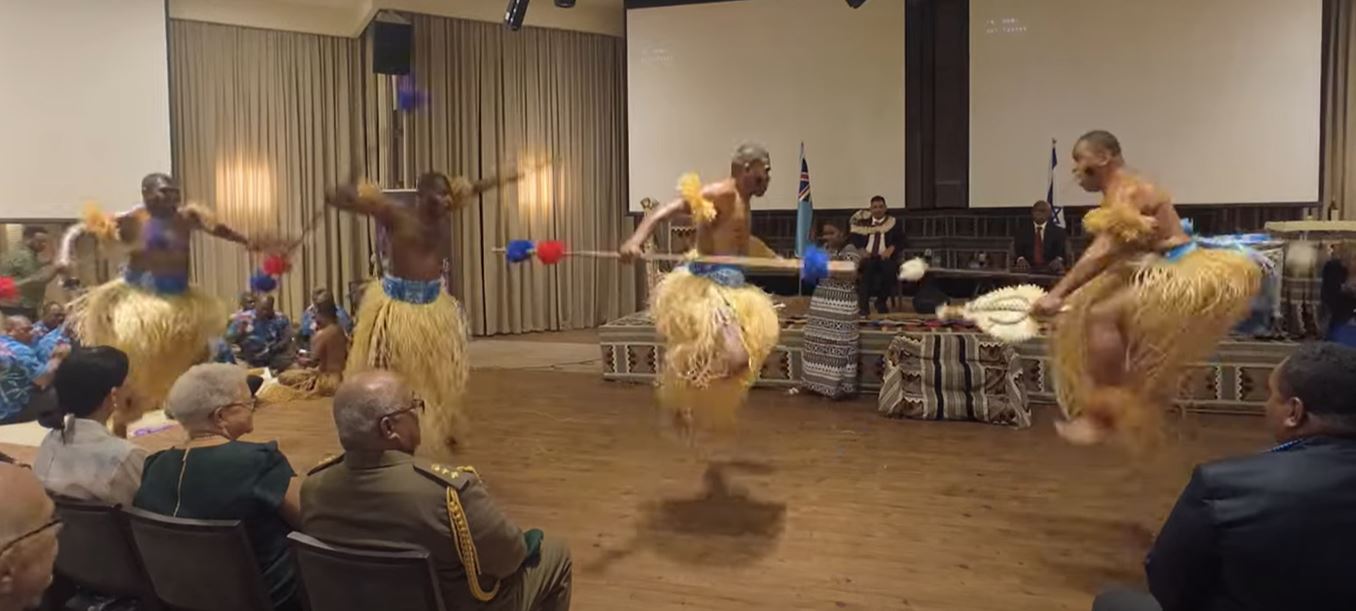
Suddenly, loud cries erupted from their throats, rhythmic syllables unfamiliar to most of the audience. The sound filled the hall, and the movements grew faster and sharper. The dancers advanced and retreated, crouched and rose, stamped their feet against the floor and swung their weapons in a coordination that transformed the group into a single, powerful body.
Within moments, the boundary between performance and ceremonial reenactment of a warrior culture seemed to disappear.
It was a highly theatrical spectacle, but not in the sense of artificial stage decoration. The movements, cries and costumes expressed a tradition in which the body becomes a storytelling instrument and the voice is an inseparable part of the message. For an Israeli audience, most of whom had little direct exposure to Fijian culture, this was an opportunity to witness something that no tourism presentation or short promotional video could quite capture.
The striking contrast between the two halves of the evening made the performance all the more memorable. Only minutes earlier, the speakers had been discussing dialogue, cooperation and peace. Now the guests were watching a powerful, uncompromising warrior tradition unfold before their eyes.
The two sides of this story are not necessarily contradictory. Together, they tell the story of a country that seeks to honor its past while building a future based on relationships, partnership and peace.
Toward the end of the evening, Ambassador Vitusagavulu and Minister Karhi descended from the stage accompanied by an honor guard of two Fijian warriors carrying swords. The warriors walked ahead of them toward the exit, providing a fitting conclusion to an event that had made no attempt to resemble any other diplomatic reception.
Fiji lies thousands of kilometers from Israel, and the journey is a long one. But for one evening in Jerusalem, the distance seemed a little smaller. Traditional clothing, ancient rituals, warriors' cries and words spoken in a language most guests could not understand all helped bridge the gap. So did the political and tourism message delivered throughout the evening: Fiji wants the world to know it, visit it and build lasting relationships with it.
As the ambassador put it, in the spirit of his closing remarks, true friendship knows no distance.