
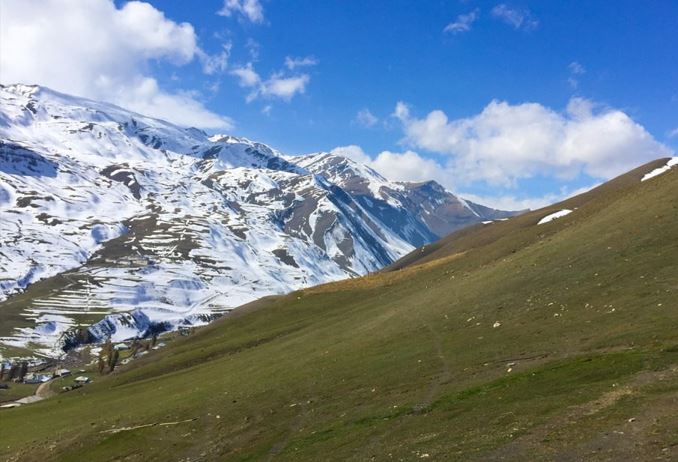
In northern Azerbaijan, facing breathtaking landscapes and an ancient stillness, a thrill awakens at the possibility of stepping onto land where the Khazar Kingdom once existed. A Jewish kingdom forgotten by maps but not by memory.
Everyone knows that Israel is the Jewish state. Far fewer know that at one point in history there was a Jewish state larger than Israel. Not merely another state, but an empire. Between the ridges of the Caucasus and the rivers of the north, a sovereign, powerful, and flourishing Jewish kingdom existed for nearly four hundred years. It was far larger than today’s State of Israel, stretching across a territory several times its size, encompassing areas that are now Azerbaijan, Georgia, Dagestan, and Ukraine. Its name was the Khazar Kingdom.
For years, this idea accompanied me like an intellectual legend. Something from the shelves of Jewish thought, from yeshiva and university, not something one could touch or smell. But in northern Azerbaijan, facing the mountains, the legend insists on becoming tangible space. Here, among winding roads, cold forests, and sharp rivers, you understand that this is not only history. It is a geography of memory.

The Azerbaijan Tourism Board in Israel quite rightly promotes the Caucasus Mountains, Mount Shahdag, the village of Laza, and the town of Qusar. They appeal to Israeli lovers of nature and skiing. But for a Jewish traveler there is a far deeper story here. It seems to me that the depth of our personal and emotional connection to these regions in their country is not fully understood. In my opinion, they could attract many more Israeli visitors if they called the region by its ancient, resonant name: “The Khazar Kingdom.” That name would reach those who are searching not only for scenery, but for roots, echoes, and shivers.
The name “Khazari” is not foreign to us. It is deeply embedded in our educational memory. Students in the religious state school system and university students of Jewish studies all learn The Kuzari, written by Rabbi Judah Halevi. A foundational work of Jewish philosophy and a cornerstone of the discipline known as Jewish Thought. Even years after closing the book, the name continues to resonate, perhaps because it bridges doubt and faith, thought and belonging. And here, at the foot of the Caucasus, it ceases to be an abstract idea and becomes landscape.
Already in the tenth century, Rabbi Hasdai ibn Shaprut, the finance minister of Córdoba, heard of this kingdom. “I was told that there exists a kingdom of the Jews, and I did not believe it,” he writes with an almost modern candor. Only when envoys arrived from Constantinople with a letter from the King of the Khazars did he understand that the rumor was true. His astonishment crosses the centuries: the knowledge that there was a place in the world where Jews were not guests, but masters of their own house.
Hasdai was stunned and wished “to inquire and know the truth, whether there is a place where there is land and a kingdom for the exile of Israel, where none rule over them and none dominate them. And if I knew that this thing was true, I would travel until I reached the place where my lord the king dwells, to see his greatness and the glory of his rank, the seat of his servants, the standing of his ministers, and the tranquility of the remnant of Israel.”
Hasdai ibn Shaprut himself did not merit seeing the Jewish Khazar Empire with his own eyes, but we can reach parts of its former territory today, within the borders of modern Azerbaijan.
According to The Kuzari, during the period of the Amoraim in Babylonia over a thousand years ago, the King of the Khazars, Bulan, dreamed that an angel appeared to him and said: “Your intentions are pleasing, but your deeds are not.” When the dream returned again and again, unsettling his spirit, he summoned representatives of the three religions and asked a simple yet piercing question: What does God truly desire?
Judaism was represented by Rabbi Isaac Sangari. The king understood that Christianity and Islam both rest upon Judaism. The result, as The Kuzari recounts, was dramatic: in the year 740 CE, the king converted to Judaism, and with him an entire kingdom. Was it the whole people? Only the elite? Historians debate this to this day.
Rabbi Judah Halevi wrapped the story in a brilliant philosophical dialogue between “the Haver" (Jewish sage) and the king. Is it historical documentation or literary creation? We may never know. But sometimes deeper truth is not a matter of precision, but of meaning. And in that sense, the Khazars were and The Kuzari continues to speak. Over the past thousand years, evidence of the Khazar Kingdom’s existence has indeed been uncovered.
The Khazar capital, Itil, stood on the banks of the Volga in what is now Ukraine. Excavations conducted there in 2008 uncovered remains of synagogues and menorahs. Findings that are difficult to dispute. But I was drawn to places where history is not documented by explanatory signs, but is present in silence.

That is how I arrived in the town of Qusar in northern Azerbaijan. Low houses. A small local market. The scent of sweet black tea. Tea houses where time moves at a different pace. I searched for Jewish remains. I found none. It turned out that only limited archaeological excavations had been conducted there, uncovering pagan artifacts from periods predating the Khazar era. But sometimes absence is the story. The name itself whispers a promise. Not proof, but a possibility. And along the Silk Road, always a corridor of peoples, merchants, and refugees, possibility alone is enough to stir emotion.

In his letters to the King of the Khazars a thousand years ago, Ibn Shaprut posed questions that intrigue us still: From which tribe does the king descend? What is the extent of his land and its borders? With whose peoples does he wage war? What language is spoken in his realm? Does war override the Sabbath?”
The King of the Khazars responds in a long epistle, reporting that he is descended from Khazar, the grandson of Japheth. His forefathers fought the earlier inhabitants of the land and expelled them. After generations, “there arose a wise and God-fearing king named Bulan, who, together with his princes and servants, entered under the wings of the Divine Presence.” One of Bulan’s descendants, a king named Ovadiah, “renewed the kingdom and strengthened the law properly and according to Halakha. He built synagogues and Yeshivot, gathered the sages of Israel, gave them silver and gold, and they expounded the twenty-four books, the Mishnah and the Talmud, and the prayer rites of the cantors.” After him arose a dynasty of kings from his seed, all bearing Hebrew names- Ovadiah, Zechariah, Manasseh, Benjamin, Aaron, and David. The letter’s author, King Joseph ben Aharon, writes that he is “a king, son of a king, of the line of kings, and no foreigner may sit upon the throne of my fathers.”
Thus the Khazar Kingdom existed for centuries, until in 965 the Russian army invaded, plundering its cities and inhabitants. The Khazars sought military and economic aid from the neighboring Khwarazmian Empire. The king of Khwarazm set conditions for his assistance. One of them was that all the Khazars had to convert to Islam before he would help them. A new king then arose, and Islamized his subjects. About fifty years later, the Byzantines and Russians finally defeated the Khazar Kingdom, destroying what remained of the Muslim state that had once been Jewish. Everything was laid waste.
On the periphery of the Khazar Kingdom, royal control was weak. Especially in the remote Caucasus Mountains, whose settlements were difficult to reach. In the southwestern reaches of the Khazar realm, in what is today northern Azerbaijan, there are villages and towns such as Krasnaya Sloboda (the “Red Village”), Qusar, Oguz, and others, where Khazar Jews continued to observe Torah and commandments. Today we can visit Jewish heritage sites and synagogues in these places and be deeply moved. But they date from a later period, after the Khazar era.

Some Khazar Jews fled to Eastern Europe, to regions that are now Hungary, Romania, and Poland. Some scholars claim that all Ashkenazi Jews descend from the Khazars, and that they introduced Khazar words into Yiddish, such as davenen (to pray) or yarmulke (skullcap), among others.
Nowadays, Qatar funds research at American universities aimed at proving that all Ashkenazi Jews descend from the Khazars rather than from our forefathers Abraham, Isaac, and Jacob. An attempt to sever the connection between the Jewish people and the Jewish Land of Israel. You can relax: genetic studies prove that our genes differ from those of non-Jewish peoples of the Caucasus Mountains. But the Qataris are attempting to engineer global consciousness through distorted "scientific research".
I recommend visiting Qusar with the Kuzari book in hand. Open it there and read a chapter or two. It is an uplifting experience that greatly enhances a journey to Azerbaijan. Near a cave on Mount Shahdag, I read about Jews hiding every Sabbath in order to refrain from labor. The words took on a different weight. The landscape became a partner in reading. The trip gained an "extra soul". The knowledge that you are walking in a region where a great, self-confident Jewish kingdom once existed expands the chest and slows the breath.

Qusar lies at the foot of the Greater Caucasus, and the mountains here are not scenery but presence. In the morning they are blue-gray, in the evening purple, and in winter white and silent. The roads leaving the town are the real experience. Twists and turns, cold rivers, and small villages that seem forgotten by time.

In this mountainous region stands Mount Shahdag, which has become a “magnet” for religious Israelis. The mountain is about a half-hour’s drive from Krasnaya Sloboda, itself a Jewish tourist attraction.

Near the summit, three luxury hotels have been built, with another scheduled to open this coming summer. The hotel complex offers abundant activities for the whole family, for all ages.

Shahdag is now a popular ski destination in winter and a lively recreation center in summer: a zipline that makes your stomach flutter, horseback riding, ATV and jeep tours, karting on a racing track, and even small electric cars for children. There is also archery and shooting, among many other attractions. If you come with children, a single day will not be enough.

There is constant movement here in a space once dominated by Khazar Jewish merchants. This blend of a weighty past and modern presence creates a sense of continuity. Not of a museum, but of life.
The name Qusar is not historically proven. It is an invitation. It whispers a promise that is easy to succumb to. It recalls that enigmatic kingdom that embraced Judaism and vanished into the mists of the Volga, inviting the traveler to imagine a hidden thread connecting a forgotten past with a Caucasian present. There is no stone inscription here and no explanatory sign. There is space. And there is silence. And in such places, silence speaks.
Qusar is not a “Jewish heritage site” in the conventional sense. It tells no story through archaeological remains, but through rhythm. Slowness, landscape, lingering. Here one understands that Jews did not live only as persecuted communities on the margins, but also as a sovereign people at the heart of space, on trade routes, between mountains, within an open world. Not as a tolerated minority, but as a shaping force.
Perhaps that is why the experience here is so powerful, precisely because it lacks clear remnants. The Khazar Kingdom left behind a faith that did not seek to be carved in stone, but to continue moving. Its memory lives not because it is backed by ruins, but because it asks the visitor to be an active partner. To imagine, to feel, to think.
And as we stand here, between the Caucasus Mountains in northeastern Azerbaijan, The Kuzari in hand and a cold mountain wind on our faces, we understand something simple and unsettling: not everything that disappears is lost. And not every kingdom needs ruins to leave a mark. Some kingdoms continue to exist precisely in memory, in the journey, and in our ability to reach them.
The name Qusar whispers a historical promise that is easy to be drawn to. Its sound recalls the Khazars, that enigmatic kingdom that embraced Judaism and vanished into the mists of the Volga, inviting the traveler to imagine a hidden thread linking a forgotten past with a Caucasian present. Qusar is not a “Jewish site” in the usual sense. It is a station of slowing down, preserved for centuries. Here one pauses to understand that Jews lived not only on the margins, but also at the heart of space on trade routes, between mountains, within an open world.
And when you stand here, between the Caucasus Mountains in northeastern Azerbaijan, you grasp something simple and profound: not everything that disappears is lost. And not every kingdom needs ruins to leave its mark.