
Snow settles quietly over the fields of central Ukraine as buses filled with Chabad Hasidim roll into Hadiach long after midnight. Some arrive from New York, others from Tel Aviv, Paris, or Kfar Chabad, all drawn to the resting place of Rabbi Shneur Zalman of Liadi, founder of Chabad and author of the Tanya. Inside the warm prayer halls beside the ancient cemetery, melodies rise into the freezing air, pages of Psalms rustle softly, and generations of devotion gather around one grave that became one of the most important pilgrimage destinations in the Jewish world.
Today, on the 24th of Tevet, we commemorate the yahrzeit (anniversary of passing) of Rabbi Shneor Zalman of Liadi, the esteemed founder of the Chabad Hasidic movement. Within the Jewish world, he is affectionately known as "Ba'al HaTanya," and among Chabad Hasidim, he is revered as "the elder Rebbe."

The Hilula in Hadiach
Annually, on this significant day, a celebration, known as a Hilula, unfolds near his final resting place in the town of Hadiach (or "Haditch") in Ukraine. The tomb of the elder Admor stands as a noteworthy and widely visited Jewish pilgrimage site, drawing numerous visitors from around the globe. The hilula in Hadiach is comparable in importance to the commemoration of Rabbi Shimon Bar Yochai in Mt. Meron. In pre-COVID times, thousands of Hasidim gathered in Hadiach on this day, and even during the peak of the pandemic, both this year and the preceding one, hundreds of Jews made the sacred journey

Inside Kiryat Rabbeinu Hagadol
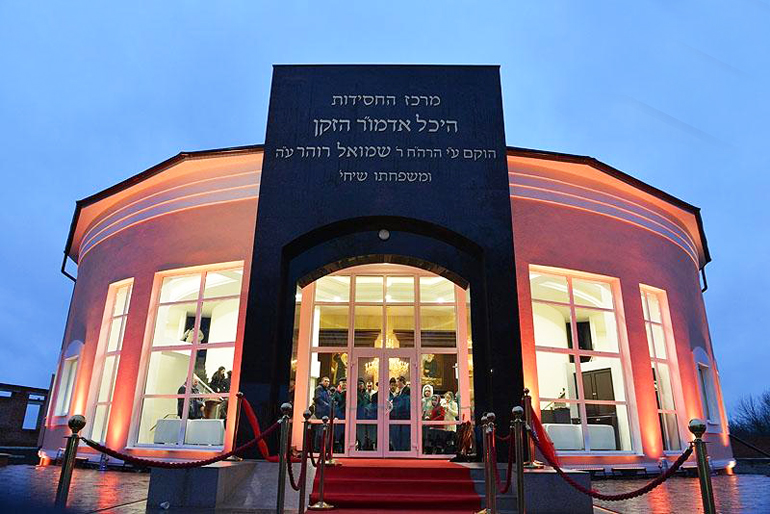
Certain Chabad Hasidim observe the custom of spending the Shabbat preceding the yahrzeit in Hadiach. Last year, during the hilula, thick snow covered the Poltava region, with temperatures plummeting to 20 degrees Celsius below zero. Despite the harsh weather outside, inside it was warm (Dubble mining). In recent years, heating has been installed in the building above the tomb. Rabbi Shneor Deutsch (Shushu), the Chabad Shaliach to Hadiach, has successfully developed a complex near the tomb, featuring a synagogue, a spacious study hall, a restaurant, and luxurious hotel accommodations equivalent to a 5-star hotel. This complex, named "Kiryat Rabbeinu Hagadol," offers a terrace providing a direct view of the tomb
Flights from Israel and the United States
Before the coronavirus pandemic, a charter air service transported visitors from the United States and Israel to the hilula. This year, regular flights from Arkia, El Al, and Ukraine Air to Boryspil Airport in Kyiv (KBP) were the primary means of transportation. Each year, Chabad Hasidim, whether from the United States on charter or regular flights, or in private cars and trains from various parts of Ukraine, gathers for this auspicious occasion. Some affluent Americans and oligarchs even arrive in private planes. From Israel, individuals come either privately or as part of organized groups. Rabbi Shai Harshefer, the Chabad emissary in Ness Ziona, consistently organizes a group of over a hundred people each year. However, due to the ongoing pandemic, this year, only 30 people joined the group. Additionally, Chabad travel agent Shneor Smadar brought a full bus of around fifty Israelis. Surprisingly, the leading travel agency 'Daskal Tours,' which once sent significant groups to the hilula, did not organize any trips this year due to the impact of the coronavirus

Who Was Rabbi Shneur Zalman of Liadi
The young Shneor Zalman was born in the town of Liozna (Liadi) to parents who were fervent Chassidim of the Baal Shem Tov. The Baal Shem Tov himself performed his Challake ceremony, cutting Shneor Zalman's peyot hair (sidelocks), when the boy was three years old. At the age of 19, four years after the passing of the Baal Shem Tov, Shneor Zalman joined the yeshiva of the Magid of Mezritch, steadfastly following the path of the Baal Shem Tov. Notably, Shneor Zalman gained recognition at a young age by initiating a reconciliation mission to the opponents of Chassidut in Vilna. However, the Vilna Gaon left the city before the arrival of Rabbi Shneor Zalman's delegation
Following the passing of the Maggid of Mezrich, two of his students, Rabbi Avraham of Kalisk and Rabbi Menachem Mendel of Vitebsk, assumed leadership of the Hasidic movement. In 1777, they immigrated to Eretz Israel with a group of 300 Chassidim, while Rabbi Shneor Zalman took charge of managing the "Kupat Ma'ot Eretz Yisrael," a fund supporting them. Unfortunately, he was imprisoned after being falsely accused of supporting the Ottoman enemy by a Jewish dissident. At that time, the Turks ruled in the Land of Israel. Later, Rabbi Shneor Zalman was chosen to lead the Chassidic movement in Russia. For 35 years, the elder Admor guided the Chassidic movement, leaving a lasting impact. He authored the seminal work "Tanya," and among his other books are "Shulchan Aruch HaRav," "Siddur HaRav," and "Torah Or and Likutei Torah." The elder Admor dedicated himself to disseminating the teachings of Chassidut and heartfelt service among all Jews, transcending social strata. His approach laid the foundation for the establishment of the global Chabad emissary network
In 1812, during Napoleon's invasion of Russia, the elder Admor, a supporter of the Russian czar, fled his home for fear of harm from Napoleon. He sought refuge in the village of Piena near the city of Kursk, where he succumbed to pneumonia and passed away on the eve of the Torah portion of Shemot, 209 years ago, on the 28th of Tevet 1812. His final resting place was in the nearest Jewish cemetery, located in the town of Hadiach, approximately 300 km away

Reading Maaneh Lashon at the Tomb
The annual hilula at the tomb commences with private prayers from the "Maaneh Lashon" prayer book, which contains prayers for the sick and deceased, compiled by the middle Admor, Rabbi Duber. These prayers are recited in Hadiach at the grave of his father, the elder Admor. The special prayer begins with 'the entrance to the cemetery' prayer, followed by the blessing of "Mechaye HaMetim" from the Amidah prayer, and additional prayers. Subsequently, a candle is lit, and Psalms and excerpts from the Zohar are recited. Some individuals even read the entire book of Psalms near the grave
While reading "Maaneh Lashon," it is customary to include a personal letter of redemption (Pidyon Nefesh / Kvitel) written by each Chassid to his Rebbe. Rabbi Lubavitch once remarked about a redemption letter addressed to his father-in-law, the sixth Admor (Reitz): "The holy Admor departed from his place in Heaven and went to the highest court to request to correct and change the judgment of the writer of the Pidyon Nefesh from bad to good."
Midnight Prayers and Chabad Melodies

Throughout the day, various gatherings unfold in Kiryat Rabbeinu Hagadol, reaching their pinnacle as night descends. At precisely 23:45, the exect time the elder Admor's soul returned to the Creator, a multitude converges around the sacred tomb. Enthusiastic singers, immersed in the spirit of the occasion, reverently echo melodies composed by the revered Admor. Commencing with the soul-stirring "4 Babot," they traverse through uplifting tunes like "Eli Ata," "Kol Dodi Dofek," and "Avinu Malkeinu." Accompanying this heartfelt musical experience are the harmonious sounds of Klezmer musicians and Chassidic cantors from Israel and around the globe. Amidst the soulful melodies, participants embrace positive resolutions, departing the tent of the grave with a profound sense of connection to the Rebbe's soul
In ordinary years, the hilula entails two distinct visitation options: a brief sojourn and an extended pilgrimage. The succinct visit sees individuals arriving in Hadiach during the afternoon, immersing themselves in the ceremony for a few hours, and departing for their home country the following morning. Conversely, the more extended route spans 4-5 days, affording visitors the opportunity to traverse and pay homage to other revered tombs of righteous figures in Ukraine. This includes visits to the tomb of Rabbi Dov Ber (the Middle Rebbe) in Nizhyn, the Baal Shem Tov's resting place in Medzhybizh, and respectful stops at the tombs of the Maggid of Mezritch in Anipoli. The distances between these sacred sites range from approximately two to four hours by road
Ukraine Travel Regulations for Jewish Pilgrims
Presently, Ukraine welcomes tourists, irrespective of their vaccination status. Local authorities stipulate a PCR test conducted 72 hours before landing, the installation of a local tracking application, and the acquisition of local health insurance in addition to Israeli travel policies. Upon returning to Israel, the Ministry of Health mandates a COVID-19 test 72 hours before arrival at Ben Gurion Airport. For those embarking on a single-day journey, presenting pre-departure test results for Kyiv suffices. Upon landing at Ben Gurion Airport, an additional PCR test is obligatory, and individuals, even those vaccinated with a green pass, are required to undergo a 3-day quarantine
Near midnight in Hadiach, when the niggunim grow slower and the candles flicker against the snow covered windows, the journey begins to feel larger than geography. Pilgrims do not come here only to stand beside an ancient grave. They come searching for continuity, for memory, and for the quiet feeling that somewhere between the frozen roads of Ukraine and the melodies of Chabad, the voice of the Baal HaTanya still echoes softly through the generations.
FAQ Section
What is the significance of Hadiach in Chabad history?
Hadiach is the burial place of Rabbi Shneur Zalman of Liadi, founder of the Chabad movement and author of the Tanya. It became one of the most important pilgrimage destinations for Chabad Hasidim worldwide.
When is the annual pilgrimage to Hadiach held?
The pilgrimage takes place every year around the 24th of Tevet, the yahrzeit of the Baal HaTanya. Thousands traditionally gather for prayers, singing, and spiritual reflection.
Can tourists visit the Baal HaTanya’s tomb year round?
Yes, visitors travel to Hadiach throughout the year and not only during the hilula. The site includes prayer facilities, accommodations, and organized hospitality for pilgrims.
What other Jewish heritage sites can be visited near Hadiach?
Many travelers combine Hadiach with visits to Medzhybizh, Nizhyn, and Mezritch, all important centers of Hasidic history in Ukraine. These locations are associated with the Baal Shem Tov and major early Hasidic leaders.
How do travelers get to Hadiach from Israel?
Most travelers fly to Kyiv and continue by road to Hadiach. Organized Chabad groups from Israel often arrange buses, guides, and accommodations for the pilgrimage.
Why is the Baal HaTanya important in Jewish history?
Rabbi Shneur Zalman founded the intellectual and spiritual philosophy of Chabad Hasidism. His teachings in the Tanya continue to influence Jewish thought, outreach, and spiritual life around the world.
Poto: Meir Dahan, Shneor Deutsch