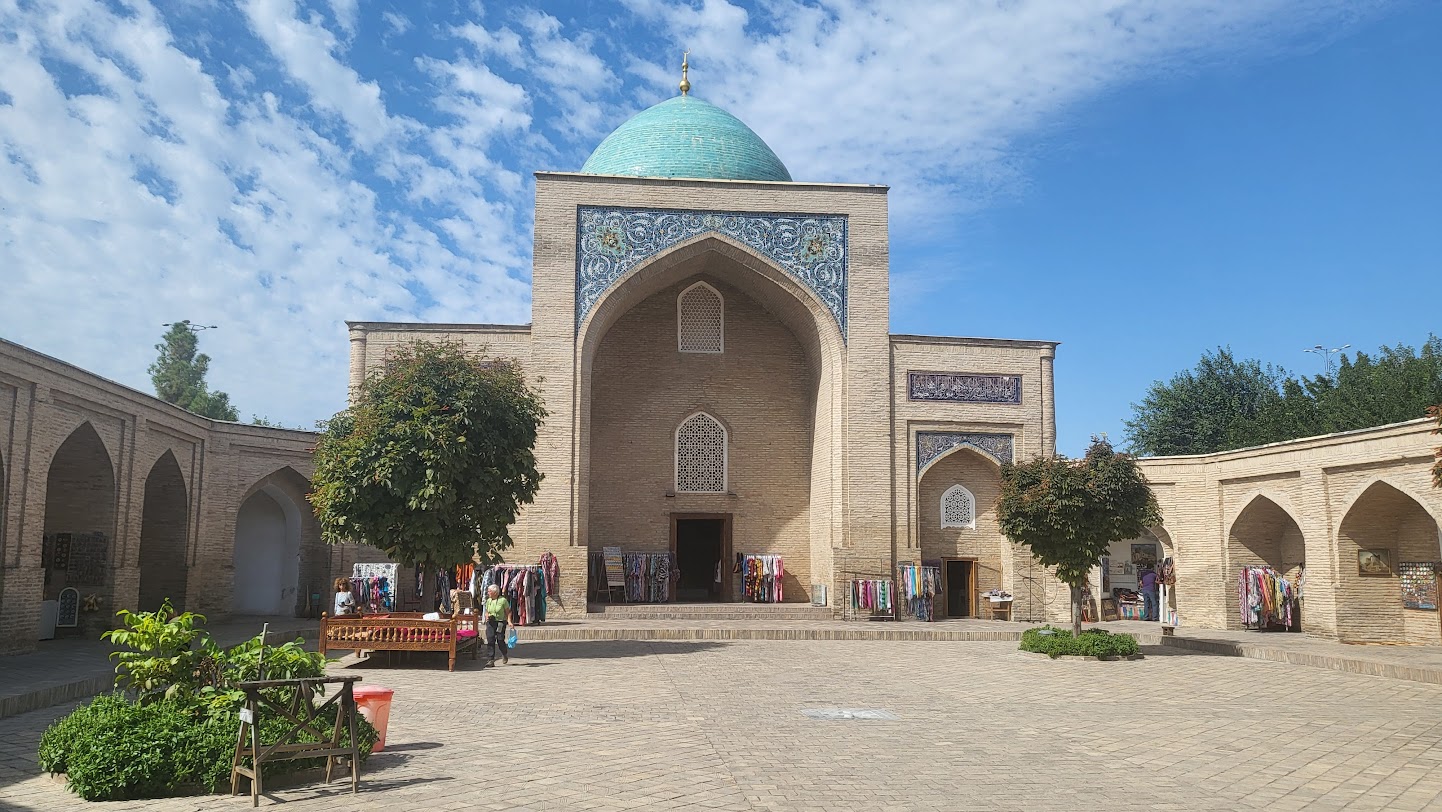
Morning in Tashkent arrives softly. The sunlight slips across wide Soviet boulevards, glimmers on turquoise domes, and filters through rows of poplar trees whose leaves rustle in the dry Central Asian wind. At first glance, Uzbekistan’s capital appears orderly, modern, almost restrained. Yet beneath the polished avenues and the marble facades lies a city layered with memory. Tashkent Jewish Heritage survives here not through grand monuments alone, but through whispers. In elderly men bent over a Chumash after morning prayers. In hidden Hebrew books once disguised as Soviet school textbooks. In melodies carried from Bukharian courtyards to Jerusalem generations ago. This is a city where exile and survival became intertwined, where refugees fleeing war once found bread when the rest of the Soviet Union starved, and where ancient Jewish customs still echo quietly inside synagogue walls.
Ancient Customs That Define Tashkent Jewish Heritage
The Yom Kippur Ritual Unlike Anywhere Else
In the heart of Tashkent, on the eve of Yom Kippur, a remarkable custom unfolds that immediately reveals the uniqueness of Tashkent Jewish Heritage. At the entrance to the synagogue stands the Gabay, holding a whip crafted from strips of donkey and ox skin. One by one, worshippers take the whip and lightly touch their backs and shoulders in a symbolic act of repentance inspired by the verse: “An ox knew his buyer and a donkey his owner's manger. Israel did not know, my people did not observe.”
The ritual feels ancient and deeply intimate. No tourists gather around it. No performances are made for outsiders. It survives simply because generations refused to let it disappear.
Only after this symbolic cleansing do congregants begin the solemn “Tefila Zackah” prayers before the Day of Atonement.
The Pilgrimage of Tisha Be'av
Another custom woven into Tashkent Jewish Heritage takes place on Tisha Be'av. While many Jewish communities visit cemeteries before Rosh Hashanah, Jews in Tashkent traditionally make their pilgrimage during the mourning day of Tisha Be'av. Families walk quietly among graves beneath the fierce summer heat, carrying flowers and memories into cemeteries where generations of Bukharian and Ashkenazi Jews now rest side by side.
Tashkent Jewish Heritage and the Soviet Century
Tashkent today is a city of nearly 2.5 million people, the largest metropolis in post Soviet Central Asia. Yet much of modern Tashkent was born from catastrophe.
During World War II, as German armies advanced across the Soviet Union, Moscow relocated military industries, hospitals, and factories eastward to protect them from bombardment. Tashkent became one of the Soviet Union’s great sanctuaries. Ambulance trains carrying wounded soldiers arrived daily. Entire factories were dismantled and rebuilt here. Among the doctors, engineers, factory managers, and refugees were thousands of Jews.
Many Jewish refugees fleeing Poland and Lithuania reached Tashkent after enduring hunger, epidemics, and brutal winters in northern Russia. The city became synonymous with survival. The famous book Tashkent the City of Bread immortalized this desperate migration toward a place where food still existed while famine consumed much of the Soviet interior.
The Jewish presence transformed the city. Ashkenazi refugees eventually outnumbered the older Bukharian Jewish community, changing the cultural texture of Tashkent Jewish Heritage forever.
Judaism Hidden Behind Soviet Covers
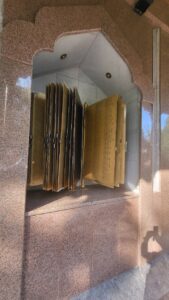
Inside the Jewish museum of Beit Menachem Synagogue stands one of the most haunting reminders of Soviet repression. Hebrew holy books are concealed inside covers of mathematics and physics textbooks. During the Soviet years, Torah study and prayer could attract the attention of the KGB. To survive, Jewish families disguised sacred texts as ordinary schoolbooks.
Standing before these volumes, one senses not only fear, but stubborn devotion. Entire generations protected Judaism quietly, invisibly, refusing to surrender their traditions.
Beit Menachem and the Living Soul of Tashkent Jewish Heritage
Once, nearly 50,000 Jews lived in Tashkent. Most eventually emigrated to Israel or the United States after Soviet restrictions eased in the 1970s. Today only a small community remains, yet the spiritual center of Tashkent Jewish Heritage continues to beat inside Beit Menachem Synagogue.
The synagogue functions almost like a Chabad house. Daily minyanim still gather here. Elderly men study Torah after morning prayers, one sometimes still wrapped in tefillin as sunlight enters through the windows.
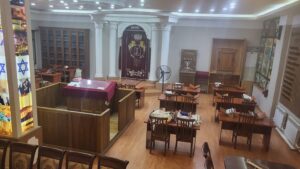
Behind the sanctuary lies a surprisingly rich Jewish museum. Glass cabinets display Bukharian embroidered garments shimmering with gold thread. Wedding robes form intricate Stars of David and seven branched menorahs. Ancient shofars rest beside ritual objects and delicate prayer stands carved from dark wood.
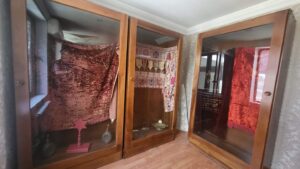
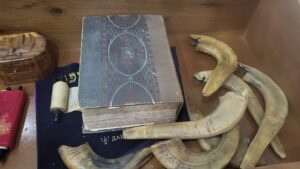
One especially striking object resembles the Quran stands used in mosques nearby, a reminder of how Jewish and Muslim cultures intertwined across Central Asia for centuries.
Even a Yiddish biography of Stalin sits on display, a surreal relic from another world.
The Modern Face of Tashkent
Unlike Samarkand and Bukhara, Tashkent does not overwhelm visitors with Silk Road grandeur. Much of the old city vanished after the devastating 1966 earthquake. Moscow responded with a massive reconstruction campaign, transforming Tashkent into a model Soviet capital of wide boulevards, apartment blocks, parks, fountains, and orderly avenues lined with trees.
Some travelers dismiss the city too quickly. That would be a mistake.
Tashkent reveals itself gradually, through details.
Hazrat Imam Complex
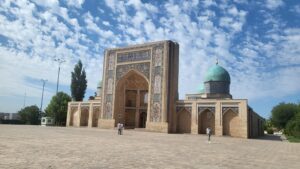
The Hazrat Imam religious complex rises behind towering minarets, preserving one of the spiritual hearts of the city. The Barak Khan Madrasa contains one of the oldest Qurans written on parchment, displayed carefully upon black marble beneath glass. Nearby, visitors can also find copies of the Quran translated into thirty languages, including Hebrew.
The complex feels serene rather than monumental. Pigeons circle above pale courtyards while worshippers move silently between the buildings.
Chorsu Bazaar and the Smell of Central Asia
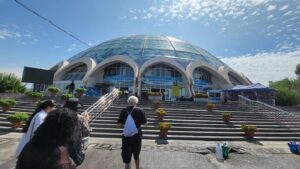
For many Israelis, Chorsu Bazaar becomes the emotional center of the city.
Beneath its vast blue tiled dome unfolds a sensory storm. Vendors pile mountains of spices beside homemade cheeses and smoked sausages. Elderly women sell pickles whose sharp vinegar scent mingles with sweet melons larger than watermelons. Butchers chop lamb rhythmically while warm bread emerges from ovens blackened by decades of fire and smoke.
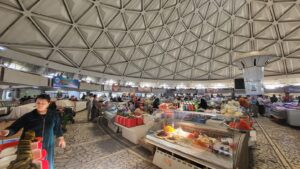
Nothing here feels industrial. Nearly everything comes from home kitchens, village farms, or family recipes carried through generations.
The Underground Beauty of Tashkent’s Metro
Beneath the city streets lies one of Tashkent’s greatest surprises.

The metro stations resemble underground palaces more than public transportation. Built partly as Cold War nuclear shelters, the stations remained closed to photography until 2018. Their beauty survived almost as a secret.
Each station carries its own artistic identity.
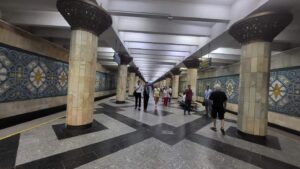
At Elisher Naboi Station, mosaics inspired by the works of Uzbekistan’s national poet cover the ceilings and walls. Another station celebrates cotton, once the defining crop of the Uzbek economy, with chandeliers shaped like delicate cotton leaves. The Cosmonaut Station glows deep blue like outer space, decorated with portraits of Soviet space heroes.
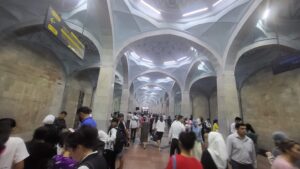
Many locals insist these stations alone justify a journey to Tashkent.
They may be right.
Emir Timur and Uzbek Identity
At the center of modern Tashkent stands a towering bronze statue of Emir Timur on horseback, dominating the city’s main square. For Uzbeks, Timur is more than a conqueror. He is the symbolic father of the nation.
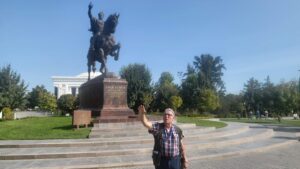
Nearby, the Amir Timur Museum explores his vast empire through paintings, manuscripts, and models of Uzbekistan’s great mosques. The museum’s golden dome glows dramatically beneath the Central Asian sun, while its exterior resembles the fur hats once worn by Uzbek warriors.
Food, Memory, and Tashkent Jewish Heritage
All You Need Is Plov
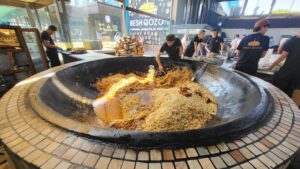
In Uzbekistan, plov is not merely food. It is ceremony.
Massive iron kazan pots bubble above open flames while rice absorbs lamb fat, onions, carrots, garlic, and spices. Entire sidewalks seem perfumed by the dish. Hundreds of portions emerge from a single cauldron. Some versions even include horse meat for adventurous diners.
Even travelers unable to eat the dish often remain hypnotized by the spectacle itself, by the smoke, the heat, the choreography of giant spoons turning rice beneath clouds of steam.
Magic City and the New Tashkent
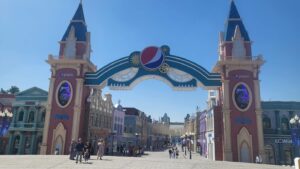
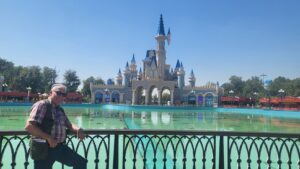
Modern Tashkent also reveals itself through unlikely places like Magic City, an extravagant amusement complex blending fantasy architecture from London, Amsterdam, Egypt, Moscow, and Switzerland into a surreal entertainment park. Restaurants, aquariums, toy stores, cafés, and amusement rides fill the space with noise and color.
It feels chaotic, excessive, strangely charming, and unmistakably modern Uzbekistan.
Independence Square and the Memory of War
Independence Square remains one of the city’s most solemn spaces. Once Lenin Square during Soviet times, it now commemorates Uzbek independence while preserving memories of World War II.
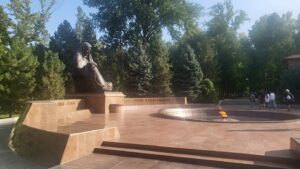
A grieving mother statue weeps eternally beside an eternal flame dedicated to fallen soldiers. Copper plaques contain the names of more than 265,000 Uzbek soldiers killed during the war, alongside tens of thousands listed as missing.
Among them are thousands of Jews from Tashkent who never returned home.
Tashkent Jewish Heritage does not announce itself loudly. It survives in fragments. In hidden Hebrew books disguised beneath Soviet covers. In Bukharian robes embroidered with fading gold thread. In elderly worshippers arriving quietly for morning prayers while outside the city races toward modernity. Tashkent itself exists between worlds, between Islam and Judaism, between Soviet concrete and Silk Road memory, between forgetting and remembrance. Perhaps that is why the city lingers so deeply in the mind. Not because it dazzles instantly like Samarkand, but because it reveals itself slowly, with patience. Like an old traveler lowering his voice at the end of a long story, allowing silence to carry the final meaning.
After discovering new things here about Tashkent, you will probably also be interested in reading articles about other cities in Uzbekistan, such as Samarkand, Bukhara, and Shakhrisabz.
You may also find useful tips and practical advice in this article, which will help make your trip to Uzbekistan more comfortable and enjoyable.
FAQ
What makes Tashkent Jewish Heritage unique compared to other Jewish communities around the world?
Tashkent Jewish Heritage preserves rare customs and traditions that survived centuries of upheaval, Soviet repression, and migration. One of the most remarkable is the Yom Kippur ritual involving a symbolic whip made of donkey and ox skin, a practice almost unknown elsewhere in the Jewish world.
Why did Tashkent become an important refuge for Jews during World War II?
During World War II, Tashkent became a sanctuary for thousands of Jewish refugees fleeing Nazi occupied territories and famine in other parts of the Soviet Union. The city offered relative safety, functioning hospitals, and access to food at a time when survival elsewhere often seemed impossible.
What can visitors see inside Beit Menachem Synagogue in Tashkent?
Beit Menachem Synagogue is both a functioning house of prayer and a living museum of Jewish Central Asian history. Visitors can explore displays of embroidered Bukharian garments, ancient ritual objects, hidden Soviet era Hebrew books, and artifacts reflecting centuries of Jewish life in Uzbekistan.
Why are the hidden Hebrew books inside Soviet textbooks so significant?
These books symbolize the quiet resistance of Jews living under Soviet rule, when Torah study and religious practice were heavily restricted. Families concealed sacred Hebrew texts inside ordinary mathematics and physics schoolbooks in order to preserve Judaism without attracting the attention of the KGB.
What is special about Tashkent’s metro stations?
Tashkent’s metro stations are considered some of the most beautiful in the former Soviet Union, designed almost like underground palaces. Decorated with mosaics, chandeliers, marble columns, and space age artwork, they combine Soviet grandeur with Uzbek artistic identity.
How does Chorsu Bazaar reflect the spirit of Tashkent?
Chorsu Bazaar captures the sensory heartbeat of the city through its smells, colors, and sounds. Beneath its massive blue dome, visitors encounter homemade cheeses, spices, pickles, fresh bread, melons, and traditional Uzbek foods that reflect generations of local culture and Silk Road history.
Who was Emir Timur and why is he important in Uzbekistan?
Emir Timur, also known as Tamerlane, is regarded as the founding father of the Uzbek nation and one of Central Asia’s most influential historical rulers. His statue dominates central Tashkent, while the Amir Timur Museum celebrates his empire through manuscripts, paintings, and architectural models.
What role did Bukharian Jews play in the history of Tashkent?
Bukharian Jews were among the oldest Jewish communities in Central Asia and helped shape Jewish life in Tashkent for generations. Many later emigrated to Israel and contributed significantly to the development of Jerusalem’s Bukharim neighborhood, carrying their traditions and culture with them.
Why does the article describe Tashkent as a city “between worlds”?
Tashkent blends multiple identities at once: Soviet and Silk Road, Islamic and Jewish, ancient and modern. This mixture creates a unique atmosphere where old synagogue traditions exist beside Soviet boulevards, futuristic metro stations, and rapidly modernizing neighborhoods.
What is plov and why is it so important in Uzbek culture?
Plov is Uzbekistan’s national dish, prepared in enormous iron pots with rice, lamb, onions, carrots, and spices. More than just food, it represents hospitality, celebration, and community, with entire streets often filled with its rich aroma.
Why do many travelers underestimate Tashkent at first?
Unlike Samarkand or Bukhara, Tashkent does not immediately overwhelm visitors with medieval architecture or famous Silk Road landmarks. Its beauty reveals itself gradually through hidden details, local traditions, quiet Jewish history, and the emotional texture of everyday life.
What can tourists experience at the Hazrat Imam Complex?
The Hazrat Imam Complex offers visitors a peaceful glimpse into Uzbekistan’s Islamic heritage through elegant courtyards, towering minarets, and historic religious buildings. The site also contains one of the oldest Qurans written on parchment and translations of the Quran in many languages, including Hebrew.
How has the Jewish population of Tashkent changed over the years?
At its peak, Tashkent was home to nearly 50,000 Jews, including both Bukharian and Ashkenazi communities. After Soviet restrictions eased in the 1970s, most emigrated to Israel or the United States, leaving behind a much smaller but still active Jewish community.
Why is Independence Square emotionally important for locals?
Independence Square commemorates both Uzbek independence and the enormous human losses suffered during World War II. Memorials, eternal flames, and plaques bearing the names of fallen soldiers create a solemn atmosphere that reflects national memory and sacrifice.
What feeling does Tashkent leave with visitors according to the article?
The article suggests that Tashkent lingers in the memory not because of dramatic landmarks, but because of its emotional depth and quiet humanity. The city reveals itself slowly, through whispers of history, hidden traditions, and small details that remain with travelers long after they leave.